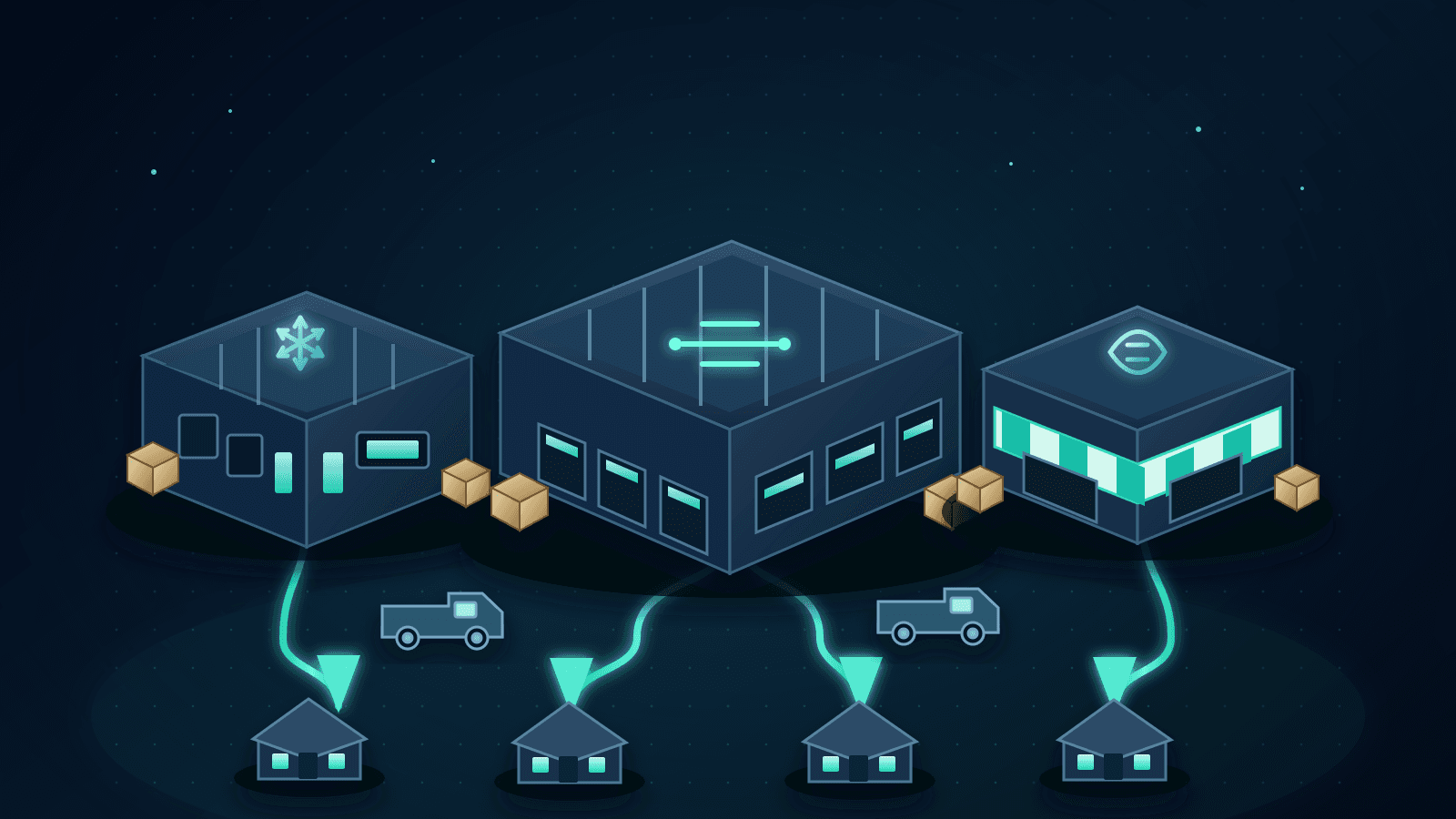
Decision map
1. Put four clocks on the same planning sheet
Start with the customer's clock: when the order must be ready or arrive, how much lateness is tolerable, and whether every item must travel together. Then add the product clock: the handling, shelf-life, and temperature conditions that the particular goods require. Add the operational clock for picking, substitution approval, packing, staging, vehicle arrival, and route execution. Finally add the project and regulatory clock: the dates by which a facility, refrigeration installation, record system, and operating process must be ready for its intended use.
These clocks interact. Moving inventory closer can shorten driving time while increasing replenishment frequency and the number of places that must execute food-handling procedures consistently. Pooling inventory in a regional center can improve assortment availability but consume more of the delivery window in transportation. Picking from a store can avoid a new building project while placing online demand into aisles and backrooms already committed to other work. The right model is therefore a fit between several constraints, rather than a contest between building sizes.
Use the map in this sequence: define the basket and promise; exclude routes that cannot satisfy product and operating constraints; verify the facility and equipment path; then compare economics among feasible options. If two models serve different promises, show that explicitly. A scheduled next-day grocery basket and a two-hour top-up order are different services. Combining them in one cost-per-order average can make an expensive network look efficient or make a useful premium service appear uncompetitive.
Working definitions
2. Describe what each node does before deciding what to call it
Micro-fulfillment here means a relatively compact facility or dedicated area that holds inventory and prepares consumer orders for a local catchment. It can be manual, automated, attached to a store, or separate from one. A regional DC serves a wider area and usually supports a larger pooled assortment; it may dispatch consumer orders directly, replenish other nodes, or do both. Ship-from-store uses inventory in an operating retail location to prepare orders for delivery. Store pickup shares some processes, but its handoff and transport costs differ.
The label alone tells you little about the process. A micro-fulfillment system may handle only packaged ambient products while employees collect fresh items elsewhere. A regional center may use local cross-docks that reduce final-route distance. A store may have a protected online-picking zone and dedicated chilled staging, making it operationally different from a shop where a picker navigates customer aisles with no reserved space. Record those details before comparing vendors or real-estate options.
Create a node profile with assortment, temperature zones, activities, customers served, inbound sources, outbound destinations, opening hours, and maximum simultaneous orders. Note whether the node only holds sealed goods or also cuts, repacks, prepares, or relabels food. Those activities matter for the compliance assessment and for staffing, sanitation, equipment, and traceability design. A network drawing with three colored icons is insufficient until the operation inside each icon has been specified.
Compare the trade-offs
3. Evaluate the whole basket, not an isolated pick rate
A fast subsystem creates value only if it accelerates or reduces the cost of the complete order. If an automated module picks pantry goods quickly but most baskets also need fresh items from a separate zone, the final completion time depends on coordination between the two flows. If a nearby store lacks several items, substitution conversations can consume the time saved in driving. If a regional center has the full assortment but an infrequent dispatch schedule, ready orders can wait longer than they take to pick.
Compare complete-basket availability, labor minutes, staging occupancy, dispatch adherence, delivery outcomes, and cost for the same order cohort. Separate basket size, product mix, delivery geography, and peak period. An average drawn from small local orders should not be compared with another model's large weekly grocery shops. The point is to learn which network serves a particular demand pattern well, not to produce a single headline ranking that conceals different operating conditions.
The table summarizes design tendencies, not guaranteed outcomes. A regional center can provide fast service in the right geography, while a poorly located local node can struggle. Similarly, store picking can be efficient when the layout and staffing support it. Use the comparison to identify the evidence required from a pilot, including the constraints that could reverse an apparently obvious choice.
| Decision dimension | Micro-fulfillment | Regional DC | Ship-from-store |
|---|---|---|---|
| Customer proximity | Local catchment by design | Wider catchment; route scheduling matters | Existing retail locations may be close |
| Assortment | Space can constrain complete-basket coverage | More scope for pooled assortment | Depends on each store's actual stock |
| Labor organization | Dedicated flow with possible automation | Dedicated flow at larger scale | Online work competes with store work unless protected |
| Inventory fragmentation | Additional local pools | Fewer larger pools | Many store-level pools shared with shoppers |
| Capital exposure | Dedicated fit-out and equipment | Larger facility and systems commitment | Existing assets plus incremental fit-out |
| Principal execution test | Can volume and basket coverage sustain the node? | Can routes meet the promised windows? | Can stock and labor support both channels? |
Calendar checked October 9, 2026
4. Separate dated legal milestones from your own project deadlines
The following calendar identifies actual US milestones relevant to many grocery networks, with scope qualifications. FDA's September 2026 reminder sets the biennial renewal window for facilities required to register at October 1 through December 31, 2026. EPA's current sector table lists January 1, 2027 and January 1, 2032 stages for supermarket refrigeration systems. FDA's traceability page distinguishes a proposed extension from Congress's direction that the agency not enforce the Food Traceability Rule before July 20, 2028.
Do not turn these dates into a universal checklist for every shop or warehouse. Registration exemptions, food activities, equipment categories, and jurisdiction-specific rules matter. A supermarket system, a remote condensing unit, and a cold-storage warehouse can fall under different refrigeration provisions. A retail food establishment may be treated differently from a distribution operation. Assign each issue to the person who can establish applicability for the actual site and equipment, and keep the supporting determination with the project record.
Your lease, equipment order, software contract, and opening date create a separate commercial calendar. Work backward from the first promised customer order through commissioning, training, inspections or approvals where required, integration, and trial operation. A favorable regulatory transition date does not make an unfinished cold room or untested order process usable. Conversely, an internal target should never be presented to executives as a statutory deadline merely because it makes the project feel urgent.
| Clock | Verified milestone or status | Network decision it informs |
|---|---|---|
| Food facility registration | October 1–December 31, 2026 renewal window for facilities required to register | Determine which nodes and responsible operators need renewal |
| Supermarket refrigeration | January 1, 2027 interim stage; January 1, 2032 later stage in current EPA sector table | Classify equipment before specifying a new installation |
| Food Traceability Rule | FDA says Congress directed no enforcement before July 20, 2028; extension described as proposed | Plan partner data exchange and node-level records with current scope review |
| Local opening readiness | Site-specific; no universal national opening date | Confirm permitted activities and required readiness before taking orders |
| Customer promise | Order-specific and continuously renewed | Release only capacity-backed slots and communicate exceptions promptly |
Evidence: fda_renewal_2026, epa_refrigeration, fda_traceability_rule
Clock one: the facility
5. Resolve the site's role before copying another location's compliance plan
FDA's food-facility registration guidance explains that an Internet or mail-order seller may qualify as a retail food establishment if it meets the relevant definition. The primary-function test considers direct consumer food sales relative to sales to other buyers. The practical implication is that a building called a dark store or micro-fulfillment center is not classified solely by its marketing name. Determine its actual activities and sales relationships. Treat this as a site-specific regulatory assessment rather than assuming that every node in the network inherits the same status.
Prepare a simple activity sheet for the review: what enters, what changes, what leaves, and who receives it. Show whether the site supplies consumers, stores, restaurants, or other facilities. Include any repacking, preparation, or transfer operation that might otherwise be hidden inside an order-flow diagram. If a proposed hub evolves from direct delivery into replenishing several stores, revisit the assessment. Operational changes can make a previously reasonable description incomplete even when the street address stays the same.
For nodes that must renew registration in the current window, assign a responsible person, validate the site information, and retain evidence of completion. For exempt nodes, retain the reasoning and reassessment trigger. Registration is only one part of readiness; review the applicable local food, building, fire, loading, and occupational requirements separately. These are planning actions for the project team, not a claim that a particular layout is legally approved or that one registration decision resolves every obligation.
Evidence: fda_registration_guidance, fda_renewal_2026
Clock two: traceability
6. Design the data handoffs while designing the physical handoffs
FDA's Food Traceability Rule concerns covered foods and entities, with exemptions and activity-specific requirements. It uses critical tracking events and associated data elements. The current agency page also describes providing information within 24 hours or another reasonable time agreed by FDA. Those provisions should not be generalized into a claim that every grocery item needs an identical consumer-level tracking record. Start with the actual foods, events, and entities in your network, then determine the records required for that scope.
Use the enforcement horizon to sequence implementation without confusing it with operational readiness. A retailer opening a new local hub now still needs reliable inventory and recall handling now. The proposed management approach is to make the receiving record usable from the first trial shipment, link it to location and inventory status, and test retrieval as part of commissioning. This avoids launching a physical flow whose supporting records must later be reconstructed across incompatible systems.
Draw every inter-node movement on the network map and name the sending and receiving record owners. If the regional center replenishes a micro-fulfillment site that occasionally redistributes to stores, the occasional transfer deserves a defined process too. Manual exceptions are often where traceability breaks. Agree how missing or inconsistent supplier data is handled, who can release the affected stock, and how corrections are recorded. The architecture comparison should include the cost of maintaining those interfaces at each proposed node.
Evidence: fda_traceability_rule
Clock three: safe operation
7. Treat the latest model Food Code and local adoption as separate facts
FDA issued the 2026 Food Code in September 2026. It is a model offered for adoption by regulatory jurisdictions, not a single automatically effective retail law throughout the United States. The local requirements applicable to a site therefore need confirmation with the responsible authority. That distinction is important for a multi-state retailer: a newly published model can inform design and review without establishing that every existing store has the same immediate legal change or implementation date.
For network planning, translate the applicable food-handling procedures into space, equipment, and time requirements. Identify temperature-controlled storage and staging, separation of incompatible products, cleaning access, handwashing arrangements, waste handling, and the response to an excursion or equipment failure. A compact node that achieves a high pick rate by omitting necessary staging or sanitation space has not demonstrated a viable operating model. Include these areas in the capacity calculation rather than allocating every square foot to sellable inventory.
Test the last ordinary handoff before food leaves your control. A picker may complete the order correctly while it waits in an unsuitable area for a late driver. A customer substitution may require reopening a packed basket. A failed delivery may return goods that cannot simply re-enter available stock. Define disposition decisions with the food-safety team and measure the time spent in each status. The purpose is a realistic operating envelope, not a universal temperature or time rule for every product.
Evidence: fda_food_code_2026
Clock four: refrigeration investment
8. Specify the equipment category before locking the opening schedule
EPA's current technology-transitions table lists an interim global-warming-potential limit of 1,400 for supermarket systems beginning January 1, 2027, followed by limits of 150 or 300 beginning January 1, 2032 depending on charge size and configuration. Other refrigeration categories have different entries and dates. These are not universal instructions to replace every existing store system on those dates. The engineering assessment must identify the applicable equipment, installation situation, and current rule provisions.
That assessment can change the economics of a new node. A low-rent site may require substantial refrigeration work, electrical capacity, ventilation, servicing access, or structural changes. A store attachment may be able to use existing infrastructure only within real capacity and regulatory constraints. Ask the engineer and equipment supplier to document the selected system, design load, expansion assumptions, service availability, and commissioning sequence. Connect those details to the expected assortment rather than treating refrigeration as a generic fit-out allowance.
Compare lifecycle options over the same horizon. Include energy, maintenance, refrigerant management, downtime, and the possibility of expanding temperature-controlled staging. Do not assume that the cheapest initial installation gives the lowest cost per order. Equally, do not attribute speculative savings to a particular refrigerant without an equipment-specific estimate. For a network decision, the key output is a costed and scheduled refrigeration plan that can support the intended operation through the relevant investment period.
Evidence: epa_refrigeration
The promise clock
9. Base the advertised service on capacity that actually exists
The FTC's Mail, Internet, or Telephone Order Merchandise Rule requires a reasonable basis for an advertised shipment timeframe and addresses delay consent or refunds when the seller cannot ship as promised. Its default 30-day provision when no time is stated is a shipment rule; it is not a recommended grocery delivery window or a blanket guarantee about arrival. Have the appropriate team assess the rule's application to the actual sales arrangement and distinguish shipment promises from delivery promises in the customer experience.
Operationally, an offered slot should account for pick, pack, staging, and transport capacity together. A store can have available drivers but no picking labor, or completed baskets but no controlled staging positions. A regional DC can have spare labor while the final departure for a destination has already closed. A micro-fulfillment node can have high machine throughput but insufficient staff for bulky or fresh items. A slot engine that considers only one resource will sell a promise that the rest of the operation cannot honor.
Define an exception path before the first peak. Specify when an order becomes at risk, what alternative window can credibly be offered, how cancellation or refund flows work where appropriate, and who communicates with the customer. Keep the message aligned with the actual order status. A label printed or a tote placed near the door is not the same as completed delivery. Measure customer outcomes against the promise shown at checkout, not against a later revised internal target.
Evidence: ftc_shipping_rule
Demand evidence
10. Use market growth as context and local order density as the investment input
The Census Bureau estimates that US retail e-commerce sales in the second quarter of 2026 were $340.2 billion, seasonally adjusted but not adjusted for price changes, representing 17.1 percent of total retail sales. That is broad retail evidence, not an estimate of online grocery demand in your catchment. It cannot establish that a particular neighborhood will support an automated fulfillment investment or that customers will pay for a narrower delivery window.
Build the local demand view from order addresses, time windows, basket composition, repeat frequency, and observed willingness to pay. Include current customers and plausible incremental demand separately. Some orders moved to a new node are transfers from an existing channel rather than new revenue. Identify whether the node improves economics for those transferred orders or merely shifts costs between budgets. A demand case that counts every rerouted order as growth will overstate the value of almost any expansion.
Inspect the distribution of orders across hours and days. A site that receives enough weekly volume can still be overloaded during a narrow evening peak and idle at other times. Test scheduled slots, cutoff changes, or delivery fees as ways to shape demand before sizing equipment around the most expensive interval. The forecasting comparison offers methods for evaluating forecasts; the network decision still needs the operational geography and basket detail that an aggregate sales forecast omits.
Evidence: census_ecommerce
Illustrative service model
11. Add the full elapsed time before celebrating a short route
Consider a hypothetical two-hour delivery promise. For a local node, assume ten minutes before work begins, twenty minutes to pick and resolve ordinary exceptions, ten minutes to pack, fifteen minutes waiting for dispatch, and thirty minutes on the route. The total is eighty-five minutes, leaving thirty-five minutes of nominal slack. Those are invented planning inputs, not measured industry performance. Their purpose is to show that driving represents only one part of the promise.
If a substitution takes an additional twenty minutes and a driver arrives twenty minutes late, the same order takes 125 minutes and misses the promise. A nearby building cannot compensate for unlimited queueing. Repeat the exercise for each architecture with actual time-stamped order data. Use percentile and peak-period results as well as averages, and inspect dependencies: packing may wait for the slowest temperature zone, while dispatch may wait for other orders assigned to the same route.
For a regional center, a wider delivery window can create useful route consolidation. For stores, dedicated pick blocks can reduce interruptions. For micro-fulfillment, balancing automated and manual zones can prevent one flow from becoming the bottleneck. Choose the intervention that improves the complete service time. The route-planning guide is relevant when route decisions are material, but route optimization cannot eliminate missing inventory or an order waiting for approval at the facility.
Transparent cost comparison
12. Compare cost per successful basket on the same boundary
Use one accounting boundary: incremental fulfillment and delivery cost for a successfully completed consumer basket, excluding the purchase cost of the goods and customer revenue. Include picking, packing, replenishment work, delivery, support, exceptions, facility costs, and equipment costs according to a stated treatment. For a store, existing rent is not necessarily an incremental cash cost, but space and labor still have opportunity costs. Show an incremental decision view and a fully allocated operating view rather than switching between them to favor one model.
The hypothetical monthly model below assumes all three configurations can serve the same scheduled delivery promise in the modeled geography. Fixed monthly cost is $60,000 for micro-fulfillment, $100,000 for a regional DC, and $20,000 for incremental ship-from-store capacity. Variable cost per completed basket is $10.50, $9.00, and $13.00 respectively. These amounts include assumed routine delivery and exception costs, and are deliberately invented. Real projects must replace them with bids, labor observations, route costs, and actual completion rates.
Average cost equals fixed monthly cost divided by completed monthly orders, plus variable cost per order. At 10,000 orders, store fulfillment is cheapest in this illustration; at 20,000, micro-fulfillment is cheapest; at 40,000, the regional DC is cheapest. That result is a consequence of the selected inputs, not a forecast of the market. Each volume also has to fit the site's real capacity. Dividing fixed cost by an unattainable order count creates an attractive but unusable business case.
| Model input or volume | Micro-fulfillment | Regional DC | Ship-from-store |
|---|---|---|---|
| Fixed monthly cost | $60,000 | $100,000 | $20,000 |
| Variable cost per basket | $10.50 | $9.00 | $13.00 |
| 10,000 completed orders/month | $16.50 | $19.00 | $15.00 |
| 20,000 completed orders/month | $13.50 | $14.00 | $14.00 |
| 40,000 completed orders/month | $12.00 | $11.50 | $13.50 |
Decision sensitivity
13. Find the crossover and then try to break it
With the illustrative inputs, micro-fulfillment and ship-from-store have equal cost at 16,000 completed monthly orders: the $40,000 fixed-cost difference divided by the $2.50 variable-cost advantage. The regional DC and micro-fulfillment cross at approximately 26,667 orders: $40,000 divided by $1.50. These are algebraic thresholds within the model. They do not establish that the required assortment, labor, route density, or temperature-controlled staging exists at those volumes.
Challenge the variables that are most likely to move. If the local node needs an extra $1 per order for replenishment and cross-node basket completion, its modeled variable advantage over stores falls from $2.50 to $1.50; the first crossover moves to about 26,667 orders. If the regional DC needs an additional $2 per order for the actual geography, its assumed variable cost becomes $11 and its prior advantage over micro-fulfillment disappears. Small changes in omitted work can reverse the ranking.
Use a ramp schedule instead of assuming mature utilization on opening day. A node might incur its fixed costs while demand and productivity develop. Model the cash required during that period, the cost of keeping the previous route available, and the exit or repurposing options if demand disappoints. The investment decision should survive a credible lower-volume case, not only the forecast that makes equipment payback look most attractive. Document what evidence would justify the next capacity increment.
Labor and layout
14. Count the work that happens outside the picking aisle
Measure receiving, put-away, replenishment, stock investigation, substitution handling, packing, cleaning, staging, loading, and customer exceptions alongside picking. A local automated system can reduce one activity while creating more frequent replenishment or manual handling for items outside the system. A store can reuse familiar staff but interrupt shelf replenishment or customer service. A regional facility can consolidate work yet require more specialized supervision and maintenance. Compare the total labor needed for the same successfully completed order mix.
Design the physical flows so people can perform that work without constant conflict. Separate customer movement, replenishment, picking, and driver collection where the site permits. Check access to equipment for cleaning and maintenance, safe manual handling, and the effects of totes or carts accumulating during peak periods. OSHA's current warehousing and distribution-center national emphasis program is listed with an information date of July 31, 2026. It is a relevant reminder to include occupational controls in facility design, not a productivity formula or a substitute for assessing the actual workplace.
For technology choices, test the complete workflow with representative products: heavy packs, fragile containers, variable-size produce, chilled goods, and items requiring special handling. Record exceptions and recovery procedures. The AS/RS, AMR, and conveyor comparison can help evaluate equipment architecture, but the network choice comes first. A sophisticated machine in a catchment with insufficient demand or an unsuitable basket mix cannot manufacture a sound business case.
Evidence: osha_warehouse_nep
Inventory clock
15. Price fragmentation in availability, waste, and working capital
Every additional inventory pool creates another place where a product can be available in the system but unavailable to the customer who wants it. A regional center can pool demand across a broad area, while local nodes need enough assortment to complete baskets within their catchments. Stores share stock with walk-in shoppers whose purchases may occur after an online reservation estimate. The network model should represent inventory at the location and status that can actually serve the order.
Do not assume a simple square-root inventory rule proves the benefit of centralization. Demand correlations, replenishment frequency, minimum case packs, shelf life, assortment differences, and service targets can change the result. Model a representative group of products with real order histories and lead times. Include slow movers and perishables, not only the fast movers that make a pilot look efficient. Examine whether a compact node's missing items cause substitutions, split baskets, canceled orders, or expensive transfers.
Measure stock accuracy at the decision point. If the availability engine sells the last unit that a shopper has already picked up, the error becomes service work. The vision, RFID, and barcode inventory comparison discusses ways to verify stock; the inventory-strategy guide examines buffers. Neither substitutes for deciding how much assortment and inventory each node must hold to meet its promised basket-completion rate.
Transport handoff
16. Include replenishment and controlled delivery in the route design
A network with short customer routes can still have costly or fragile replenishment. Count the vehicles, unloading windows, temperature zones, and handling steps needed to feed local nodes. A micro-fulfillment site may depend on several small replenishment waves to maintain a broad assortment in limited space. A store may already receive deliveries but need extra volume at times that conflict with online peaks. A regional center may support efficient inbound consolidation while sending longer outbound routes. Evaluate both directions together.
FDA's sanitary transportation rule addresses covered shippers, loaders, motor or rail carriers, and receivers, with requirements and exemptions that depend on the operation. Its scope includes suitable equipment, sanitary practices, and appropriate temperature controls where needed. Do not assume every consumer-delivery arrangement has identical regulatory treatment. Establish applicability and responsibilities for each flow, then document the operational requirements in the carrier and site process. The commercial contract and the food-safety process need to describe compatible handoffs.
Test missed departures, vehicle breakdowns, absent customers, and returned orders. Decide who can authorize a re-delivery, what evidence is needed before returned goods can be considered for reuse, and when a product must be held for disposition. A delivery-cost estimate that assumes every attempt succeeds understates the work. Keep exception costs and outcomes visible by route type so that a short geographic radius does not hide poor dispatch reliability or repeated delivery attempts.
Evidence: fda_transport
Traceability drill
17. Test inter-node transfers without inventing a consumer tracking duty
FDA's traceability FAQs explain that covered intracompany movements between different street addresses can constitute shipping and receiving events. They also distinguish direct-to-consumer sales from shipping records under this rule and clarify that the rule does not require linking received traceability lot codes to individual consumer sales. That distinction matters when designing a network: the regional-to-local transfer and the local-to-household transaction should not automatically be assigned the same record obligation.
As a proposed operational drill, select an inbound lot and ask each affected node to show its current inventory status, relevant transfer history, and ability to prevent further allocation while the event is investigated. Include a partial case, a transfer between locations, a damaged label, and an order already staged. These are test conditions, not a claim that the regulation requires one particular software architecture. The goal is to establish whether the company's chosen controls work through ordinary exceptions.
Centralized record storage can simplify administration, but access must remain usable at the site and during disruption. Test a local network outage, an absent administrator, and an inconsistent supplier file. Record the time and manual work required to retrieve and reconcile the information. If adding five local nodes multiplies that effort, include it in the expansion decision. A network is easier to manage when record ownership and exception handling are designed before inventory begins moving among locations.
Evidence: fda_traceability_faq
Sequence the investment
18. Use the calendar to preserve choices while evidence improves
Begin with the least irreversible experiment that can answer the important question. A retailer considering a dedicated local facility can first measure store-based demand and complete-basket requirements in the target catchment, provided the trial operation meets its applicable requirements. A regional operator can test scheduled delivery density before committing to several local nodes. The experiment should reproduce the order mix and handoffs that matter, rather than selecting only easy products or friendly customers.
Place decision gates ahead of long commitments. Before the lease, verify use and infrastructure assumptions. Before the equipment order, verify category, layout, design load, and commissioning requirements. Before offering new slots, verify inventory and labor readiness. Before scaling, verify complete-order cost and service under peak conditions. This sequencing does not eliminate uncertainty; it prevents avoidable uncertainty from being carried into commitments that are expensive to reverse.
The dates in the regulatory calendar should enter the same project register with clear status: in force, future stage, proposal, enforcement direction, or local determination pending. Give each entry an owner and a next-check date. This article's October 2026 research is a dated planning snapshot. Recheck the authoritative sources before an equipment purchase or site launch because the applicable facts include both the current rule and the actual project configuration.
- Define the service envelope
Choose the order cohort, assortment, delivery geography, and promise. Record the current cost and failure modes before changing the network.
- Resolve node and equipment scope
Document the food activities, facility role, refrigeration category, local readiness needs, and responsible owners for applicable requirements.
- Run a representative operating trial
Measure complete baskets, staffing, staging, dispatch, replenishment, inventory discrepancies, and product disposition under ordinary and peak conditions.
- Recalculate before committing
Replace illustrative inputs with observed costs and credible demand. Approve the next capacity step only if the service, controls, and lower-volume economics remain acceptable.
Network choice
19. Match each model to the demand pattern it can serve well
For a dense catchment with repeat local demand and a manageable assortment, micro-fulfillment may justify dedicated labor and equipment. The decisive evidence is enough complete baskets within the node's capacity and cost envelope. For dispersed demand with larger scheduled baskets and a broad assortment, a regional center may benefit from pooling and consolidated routes. Its decisive evidence is route feasibility and customer acceptance of the promised windows. Neither recommendation follows from population density or building size alone.
For a retailer with established nearby stores, ship-from-store may provide a practical way to use existing stock and learn demand patterns. Its decisive evidence is accurate availability and enough protected operating capacity to serve both channels. A store that consistently damages the walk-in experience or relies on unrecorded overtime is not providing low-cost online fulfillment simply because no new warehouse lease appears in the budget. Charge the work to the decision that creates it.
A hybrid can be the right result when roles are explicit. A regional center can hold the long tail, selected stores can handle local urgent demand, and a dedicated local node can serve a proven dense market. Define which orders each route accepts and how exceptions transfer. Avoid an unrestricted routing system that moves every problem to another node. The final network plan should state its promise, capacity, inventory scope, cost boundary, applicable readiness gates, and the evidence that will trigger its next redesign.
FAQ
Is micro-fulfillment always automated?
No. In this guide it describes a compact local fulfillment operation, which can be manual, automated, or mixed. Automation is a separate design choice. The economic question is whether the operation can complete enough suitable baskets at a reliable total cost. Include fresh items, bulky goods, exceptions, replenishment, packing, and staging when assessing a system. A high automated pick rate alone does not demonstrate complete-order capacity or delivery performance.
When does ship-from-store stop being the cheapest option?
There is no universal order threshold. It depends on incremental staffing, travel through the store, stock accuracy, staging, delivery density, and the effect on walk-in service. In the deliberately hypothetical model here, micro-fulfillment crosses the store option at 16,000 completed monthly orders before sensitivity changes. That figure is a calculation from invented inputs, not an industry recommendation. Replace every input and test whether the required volume fits the site.
Does the Food Traceability Rule require tracking every grocery order to a consumer?
The FDA FAQ distinguishes direct consumer sales from the shipping events covered by the rule and says it does not require linking received traceability lot codes to individual consumer sales. Covered foods, entities, activities, and exemptions still need assessment. Retailers can choose additional operational controls for recalls or customer service, but should distinguish those choices from the rule's specific obligations. The transfer between two company locations can raise different record questions from the final consumer transaction.
Can every store use July 20, 2028 as its food-safety implementation date?
No. The dated discussion here concerns FDA's stated enforcement direction for the Food Traceability Rule and its proposed compliance extension. It is not a general delay of food-safety duties, local requirements, or operational controls. Applicability depends on the actual activity and products. Use a site-specific register and recheck the authoritative sources before making a project commitment. Existing handling, inventory, and recall processes must be addressed in the operating plan from launch.
Does the 2026 Food Code immediately replace local retail rules everywhere?
FDA presents the Food Code as a model for adoption by jurisdictions. Publication of the 2026 edition does not by itself establish that every location has adopted the same provisions on the same date. Confirm the applicable local requirements and planned activities with the responsible authority. A national design standard can still be useful, but the project must distinguish its internal standard from the rules and approvals applicable to the particular site.
Can a regional DC compete with local nodes on delivery speed?
It can in the right geography and with an appropriate service promise, especially when scheduled routes and broad assortment reduce other delays. Compare the entire order cycle, including queueing and dispatch, not just driving distance. A local node may be preferable for some urgent baskets, while the regional center serves planned larger orders. The comparison should use the same order cohort and promise, or clearly show why the services and prices differ.
Hypothetical network review
A grocery retailer discovers that the missing constraint is chilled staging
Imagine a fictional retailer with six stores and one regional distribution center. Online orders are growing in two dense catchments, and management is considering a compact automated fulfillment area attached to one store. The proposed system handles packaged products quickly, while fresh items remain in a manual workflow. The project initially compares equipment pick rate with the current store-picking rate. All details in this case are invented to illustrate the decision method; no real retailer result is claimed.
A complete-order trial changes the question. The automated portion finishes early, but baskets wait for fresh items and substitution decisions. During the evening peak, chilled staging fills before drivers arrive. Additional completed totes cannot be released safely into the available space, so the apparent picking capacity is unusable. The team also finds that the local assortment misses several frequent basket items, leading to transfers from another store. Those transfers add handling, delay, and record work that were absent from the original financial model.
The revised proposal gives each architecture a defined role. The regional center remains the source for broad scheduled baskets. The two local catchments continue a controlled store trial with protected pick windows and revised staging. The dedicated module is evaluated only for the order mix it can complete within the site's physical limits. Engineering reviews refrigeration scope and the planned commissioning date, while the food-safety and systems teams map receiving, transfers, and product disposition. Procurement requests a costed design that includes the manual zones.
The investment committee now receives a decision it can inspect: observed labor and elapsed time by order type, a space-constrained peak capacity, a revised monthly cost model, and an applicability register with owners. It does not receive a promised percentage uplift derived from a machine specification. The project may still proceed, but its justification depends on completed baskets and a workable operating calendar. If demand remains below the revised threshold, the staged approach preserves the option to expand later without treating early caution as project failure.
- The limiting resource was complete-order staging, not the fastest picking subsystem.
- Basket gaps created inter-store work that the first cost model omitted.
- Equipment and facility readiness belonged on the same calendar as the advertised customer service.
- The fictional outcome is a better decision process; no empirical savings, throughput gain, or food-safety result is asserted.
Research and modeling scope
Primary-source information was checked on October 9, 2026. US regulatory references are limited to the specific facts attributed to FDA, EPA, FTC, and OSHA; this article is a network-planning comparison, not a site-specific legal determination. The FDA traceability proposal and congressional enforcement direction are kept distinct, and the Food Code is identified as a model requiring jurisdictional adoption. Census figures describe broad retail e-commerce, not local grocery demand. All timing examples, cost inputs, crossover calculations, and the case study are explicitly hypothetical original analysis. The cost model uses USD per completed basket, excludes goods cost and revenue, and assumes comparable scheduled-service feasibility before comparing architectures. A live decision requires product-specific food controls, actual labor and route data, an equipment assessment, applicable local requirements, and fresh verification before investment or launch.
Research ledger
Sources and further reading
- FDA Reminds Food Facilities of Biennial Renewal RequirementsUS Food and Drug Administration · 2026-09-29
October 1–December 31, 2026 renewal window for facilities required to register; exemptions must be considered separately.
- Questions and Answers Regarding Food Facility Registration, Seventh EditionUS Food and Drug Administration
Retail food establishment and Internet-sales classification discussion; not a determination for any proposed node.
- FSMA Final Rule on Requirements for Additional Traceability Records for Certain FoodsUS Food and Drug Administration
Current page distinguishes proposed compliance extension and congressional no-enforcement direction before July 20, 2028; scope and exemptions apply.
- Frequently Asked Questions: FSMA Food Traceability RuleUS Food and Drug Administration
Intracompany transfers, retail receiving records, and direct-consumer distinctions.
- Food Code 2026US Food and Drug Administration
Latest model Food Code at research date; jurisdictional adoption is distinct from FDA publication.
- Technology Transitions HFC Restrictions by SectorUS Environmental Protection Agency
Current supermarket-system stages and category distinctions; actual installation applicability requires equipment-specific review.
- Mail, Internet, or Telephone Order Merchandise RuleFederal Trade Commission
Advertised shipment timing, default timing, and delay handling; shipment is not identical to delivery.
- FSMA Final Rule on Sanitary Transportation of Human and Animal FoodUS Food and Drug Administration
Covered transportation activities, responsibilities, controls, and exemptions.
- Quarterly Retail E-Commerce Sales Report: Second Quarter 2026US Census Bureau
Seasonally adjusted broad US retail figures, not grocery-specific or a local demand forecast.
- National Emphasis Program on Warehousing and Distribution Center OperationsOccupational Safety and Health Administration · 2026-07-31
Current directive listing; referenced as occupational-design context, not a performance benchmark.
Make the fulfillment decision with complete-order evidence
Connect orders, stock, labor, staging, and delivery data to compare network options and identify the constraints that actually shape service and cost.
Discuss your fulfillment workflow