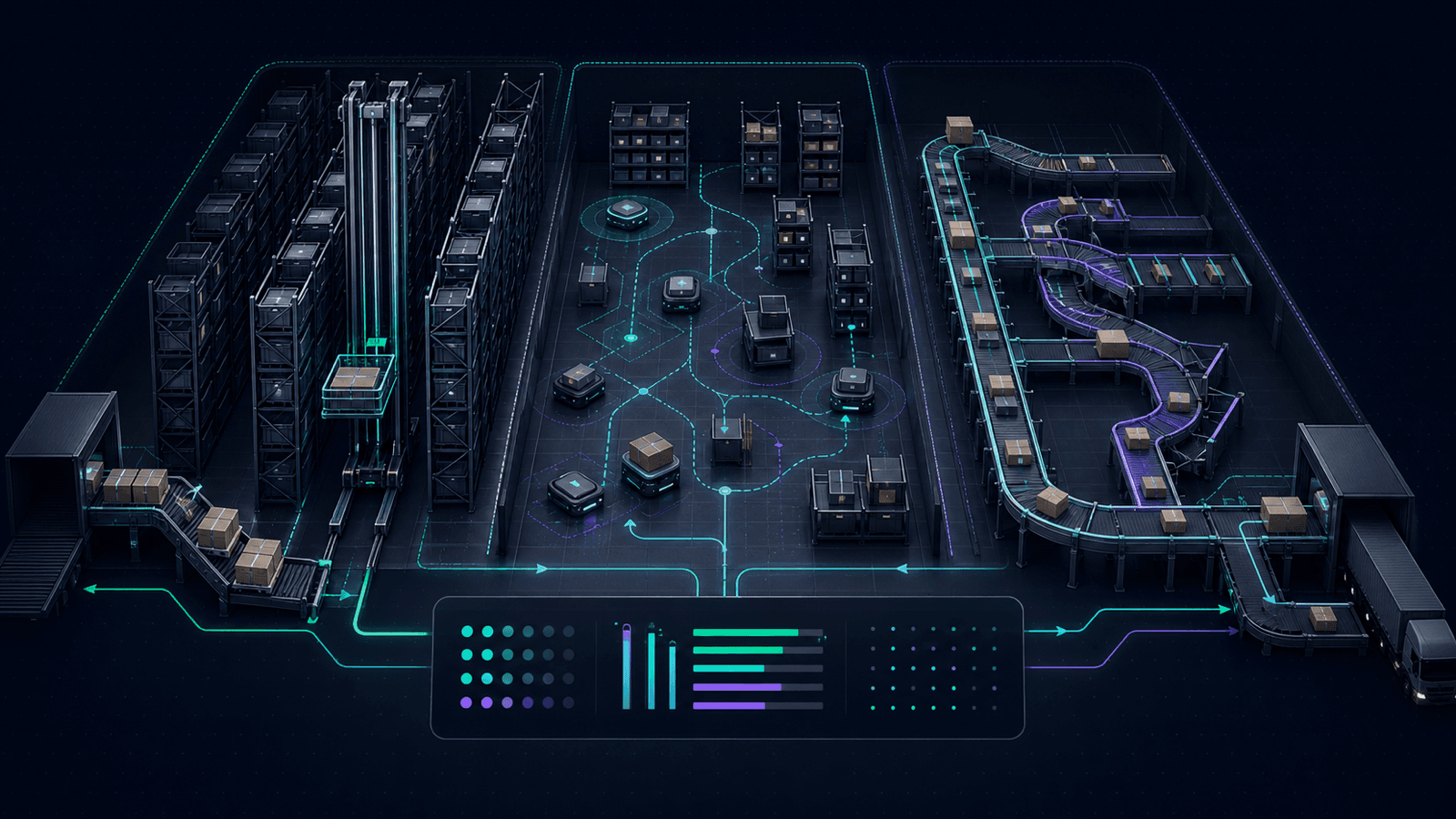
Field verdict
The best warehouse is usually fixed where physics rewards certainty and flexible where the business rewards change
AS/RS wins the density contest when its storage media, load standard, vertical envelope, fire strategy, replenishment pattern, and input/output capacity align. Conveyor wins the deterministic-flow contest when cartons or totes move repeatedly between fixed points at sustained volume. AMRs win the reconfiguration contest when missions can be rerouted, capacity can be added in smaller increments, and mixed traffic can be governed safely. None automatically wins the warehouse because each can shift a bottleneck into picking, induction, packing, replenishment, lifts, doors, charging, or shipping.
Operators should resist technology labels that hide topology. AS/RS includes unit-load cranes, mini-load machines, shuttles, vertical lift modules, carousels, and cube-based or robotic retrieval systems with very different capacity and access behavior. AMR can mean person-following carts, point-to-point load carriers, rack-moving systems, tote-handling vehicles, forklifts, or mobile manipulators. Conveyor includes belt, roller, chain, accumulation, spiral, merge, divert, and sortation equipment. The right comparison is between complete operating concepts with specified load, station, software, and exception design.
A sensible rule is to harden the stable core and postpone the uncertain edge. A retailer with a durable reserve-storage profile may use AS/RS for dense inventory, conveyor for predictable outbound consolidation, and AMRs to connect changing value-added services. A 3PL with short customer contracts may favor mobile transport and modular workcells, while keeping only essential fixed conveyance. A parcel hub with reliable lanes and recurring destinations may justify extensive sortation but still use mobile robots for irregular replenishment or exception moves.
The operator's decision is therefore conditional, not ideological. Draw the physical flow, quantify the peak hour, model the queues, name the exceptions, and rehearse recovery. The winning architecture moves the required order mix safely through the true constraint, stays supportable on the worst staffed shift, and can absorb a plausible change without turning the original business case into sunk-cost protection. A supply-chain software layer should make these states visible rather than concealing them behind a single automation dashboard.
Evidence: mhi-asrs, mhi-conveyor-guide, nist-robot-test-facility, bls-iif-2024
Technology boundaries
Define the three systems by the work they perform and the constraints they impose
MHI defines AS/RS as equipment and controls that handle, store, and retrieve material under a defined degree of automation. The storage locations and access machinery form a coupled system. That coupling can create excellent density and predictable inventory movement, but it also makes load dimensions, rack geometry, input/output ports, fire protection, structure, controls, and maintenance access part of one design. An AS/RS proposal is not just a storage quote; it is a long-lived operating cell with building and software consequences.
AMRs decouple movement from a permanently installed path to varying degrees. They navigate through a mapped operating environment, execute missions, interact with people and equipment, and may carry racks, carts, pallets, totes, or attachments. Flexibility does not mean no infrastructure. Floors, Wi-Fi or other communications, charging, traffic rules, maps, doors, lifts, pickup interfaces, pedestrian crossings, staging, and fleet control all affect capacity and safety. The route is software-defined, but the operating zone remains physical.
Conveyor and sortation create a fixed transport network. Powered or gravity sections move loads; accumulation controls spacing and buffering; merges combine flows; diverts and sorters route items to destinations. Fixed travel is not a defect when the flow is stable. It can be the reason the system achieves deterministic timing and efficient high-volume movement. The tradeoff appears when a lane, destination, pack format, or process sequence changes and steel, controls, guarding, egress, mezzanine, or building services must change with it.
Hybrids add another boundary: the handoff. A tote leaving AS/RS for conveyor, a pallet transferred from conveyor to AMR, or a rack presented by AMR to a pick station needs a precise contract. Define load orientation, identity, dimensions, weight, center of gravity, destination, readiness, ownership, sensor confirmation, timeout, rejected state, and recovery. Most hybrid instability is not caused by one technology failing in isolation; it appears when two nominally available subsystems disagree about the state of the same load.
| Decision factor | AS/RS | AMRs | Conveyor and sortation |
|---|---|---|---|
| Primary job | Store and retrieve controlled loads from defined locations | Execute flexible transport or goods-to-person missions | Move, accumulate, merge, sequence, and route loads on fixed paths |
| Best demand shape | Repeatable storage/retrieval with valuable vertical density | Variable routes, stations, products, or scalable mission demand | Stable origin-destination flows with sustained high volume |
| Physical commitment | High: rack, machines, ports, building envelope, and services are integrated | Moderate: vehicles are mobile, but zones, interfaces, charging, and traffic design matter | High along the route: supports, guarding, controls, and crossings become facility infrastructure |
| Capacity increment | Often aisle, level, shuttle, port, or module dependent | Often added vehicles plus fleet, charging, traffic, and station capacity | Often zones, lanes, sorter capacity, or parallel line changes |
| Density | Usually the strongest candidate when designed for vertical and compact storage | Depends on the solution; transport AMRs do not inherently increase storage density | Consumes route and accumulation space but can reduce ad hoc staging |
| Failure behavior | A port, lift, crane, or control fault can affect a concentrated storage domain | Individual units can be isolated, but traffic or fleet-control faults can reduce the whole fleet | A stopped merge, sorter, or trunk line can block broad downstream flow |
| Change effort | Highest when storage geometry or throughput topology changes | Lowest for route changes that stay within validated capacity and safety boundaries | Low for software destinations within design; high for physical path or load changes |
| Operator priority | Inventory accuracy, port queues, replenishment, recovery access | Traffic, charging, pickup quality, exceptions, pedestrian interaction | Jam prevention, accumulation state, merge discipline, LOTO, fault isolation |
Evidence: mhi-asrs, mhi-conveyor-guide, iso-3691-4, amr-ejor-review
Flow discovery
Build a load-and-decision map before asking any supplier for throughput
Start with a representative operating calendar, not an annual average. For each fifteen-minute or thirty-minute interval, capture receipts, putaway, replenishment, order release, picking, consolidation, packing, sort destinations, carrier cutoffs, returns, and value-added work. Identify whether the peak is a broad surge or a short cliff. A system sized to daily average can fail every cutoff; a system sized to one unrepeatable historical spike can strand capital. Model ordinary peak, promotional peak, recovery peak, and growth cases separately.
Create a load census. Record unit, tote, carton, tray, case, pallet, rack, and irregular item dimensions and weights, including tails rather than averages. Capture surface, rigidity, overhang, straps, labels, barcodes, reflectivity, center of gravity, damage, temperature, and contamination. Test actual packaging. A conveyor that handles the median carton may reject polybags and bowed cases; an AS/RS tote may lose usable cube to dividers; an AMR handoff may become unstable with offset loads.
Map order structure: lines per order, units per line, SKU velocity, co-occurrence, single-line share, wave or waveless release, priority orders, carrier service, and required sequence. Storage and movement cannot be optimized independently. Dense storage that produces too many retrievals through too few ports will starve picking. Fast conveyor that delivers unbalanced work to pack stations will only build queues. A fleet sized for average travel can gridlock when several zones release missions at once.
Mark every decision point and owner. The WMS may decide inventory allocation and work priority; a warehouse execution system may balance resources; a warehouse control system may route equipment; a fleet manager may assign vehicles; programmable controllers may execute local logic. If two layers can release the same work or change the same destination, congestion and duplicate missions follow. The discovery output should show what decision is made, from which data, at what latency, with what fallback, and who may override it.
- Time profile: interval demand, cutoff cliffs, replenishment peaks, recovery peaks, and seasonality.
- Load profile: dimensions, weight, surfaces, overhang, identity, condition, and tail cases.
- Order profile: lines, units, co-occurrence, priority, destinations, and release logic.
- Path profile: origin-destination matrix, distance, crossings, vertical moves, and congestion windows.
- Exception profile: unreadable, missing, damaged, oversized, short, duplicate, late, and manually held loads.
- Decision profile: allocation, release, routing, sequencing, recovery, and override ownership.
Evidence: robotized-warehouses-review, asrs-ejor-survey, amr-ejor-review
Throughput reality
Sustained flow is governed by the slowest coupled resource, not the fastest component
A sorter may have a rated item speed, an AS/RS machine a cycle calculation, and an AMR a maximum travel velocity. Those numbers are inputs, not answers. End-to-end throughput depends on induction quality, scan success, spacing, merge contention, station work time, replenishment, port availability, elevator or lift capacity, battery and charging, empty-container returns, exception handling, and downstream clearance. When any queue reaches its physical limit, upstream resources block and rated capacity becomes irrelevant.
Model variability explicitly. Two pack stations with the same average work time can produce very different queues if one has high variance from gift wrap, documentation, or fragile items. AMR travel time changes with congestion and human interaction. AS/RS retrieval sequences change with storage assignment and dwell behavior. Conveyor merges can be starved or saturated depending on release control. Use discrete-event simulation or another suitable flow model when interactions and blocking are material, but validate the simulation against observed manual or pilot data.
Quote three capacity levels. Theoretical capacity describes physics under ideal conditions. Demonstrated capacity comes from a witnessed test with stated load mix and duration. Planned sustained capacity applies conservative availability, break coverage, replenishment, exceptions, and downstream constraints for the operating window. Require a confidence range and assumptions. A five-minute burst is not evidence for a four-hour carrier cutoff, and a supplier's reference site is not evidence for your item mix.
Design buffers deliberately. Accumulation can decouple short disturbances, but buffer space is not a substitute for resolving a chronic imbalance. Name the purpose of each buffer, its unit capacity, state logic, maximum age, overflow route, and recovery sequence. If a downstream station stops, decide which upstream processes continue and for how long. If the answer is nowhere to put work, the warehouse has a coupled single system even if it purchased several technologies.
| Question | AS/RS evidence | AMR evidence | Conveyor/sortation evidence |
|---|---|---|---|
| What is the true constraint? | Port, crane, shuttle, lift, station, or replenishment simulation | Mission, traffic, pickup, charge, station, and fleet-controller model | Induction, merge, accumulation, scan, divert, chute, and downstream model |
| What mix was tested? | Single/dual cycles, SKU locations, tote/pallet tails, sequence | Routes, payloads, obstacles, priorities, blocked paths, battery state | Actual cartons, bags, labels, gaps, destinations, recirculation |
| How long was it sustained? | Peak operating window including replenishment and exceptions | Full shift or representative cycle including charging and traffic | Cutoff window including jams, clears, destination saturation |
| What happens at failure? | Accessible inventory domains, alternate ports, manual retrieval plan | Unit isolation, traffic degradation, lost localization, fleet-server loss | Zone stop, accumulation fill, bypass, manual divert, restart sequence |
| How does growth enter? | Port/aisle/module/storage slot increments and shutdown needed | Vehicles, chargers, wireless, fleet license, intersections, and stations | Additional lane/zone/sorter capacity, controls, supports, and egress |
Evidence: asrs-ejor-survey, amr-ejor-review, robotized-warehouses-review, nist-mobile-robot-performance
SKU and order fit
Velocity, dimensional spread, affinity, and lifecycle determine what should move and what should stay
AS/RS benefits from controlled load units and storage assignments. High inventory value per cubic unit, limited floor area, tall clear height, repeatable tote or pallet geometry, and goods-to-person demand can strengthen the case. But high SKU count alone is not sufficient. Examine inventory depth, touches per location, replenishment, lot or expiry rules, slow-moving tails, and port demand. A very fast SKU may belong near a workstation rather than consume repeated machine cycles; a very irregular item may not fit the media at all.
AMRs benefit from mission separability. If work can be expressed as move this load from a known pickup state to a known destination, the fleet can flex among routes and priorities. They are useful when origins and destinations change or when automation must coexist with a live brownfield. Fit deteriorates when pickup presentation is inconsistent, routes are congested, payloads are unstable, travel distances are too long for the required throughput, or workstations cannot absorb arrivals. Adding robots cannot repair a blocked handoff.
Conveyor and sortation benefit from repeated flow along stable corridors. They fit high-frequency carton, tote, or parcel movement where accumulation and route decisions create value. They become less attractive when products cannot ride the media, destinations move frequently, layout access is needed, or volume is too low to justify a fixed network. Mixed load types may need separate lines or containers, which changes handling steps and space.
Segment instead of declaring one warehouse-wide winner. A-class unit demand may flow through a forward pick module and conveyor, medium movers through tote AS/RS, and long-tail or irregular items through manual or AMR-assisted zones. Pallets may use unit-load AS/RS for reserve while AMRs replenish ergonomic pick faces. Recalculate segmentation as assortment, packaging, and channels change. The automation boundary is an operating policy, not a permanent statement about a SKU.
Evidence: mhi-asrs, mhi-conveyor-guide, asrs-ejor-survey, amr-ejor-review
Density and building fit
AS/RS can monetize vertical cube, while every option still competes for access, fire, structure, and recovery space
Density should be measured as usable inventory positions per building cube after clearances, structure, fire protection, machinery, maintenance aisles, input/output, decant, staging, empty containers, and exceptions. Vendor graphics often show the storage face but not the operating apron. An AS/RS can use height and compact access effectively, yet ports and replenishment queues may consume valuable floor area. A cube-storage system may pack totes densely but impose access sequencing and tote-eligibility constraints.
AMRs do not automatically create storage density. Rack-moving variants can change aisle needs and bring inventory to people, while transport AMRs mainly change movement labor and route flexibility. They still need safe operating zones, passing behavior, charging or battery exchange, staging, and pickup geometry. A fleet that looks compact at average volume can occupy intersections and queue in front of stations at peak. Model vehicles in motion and waiting, not just parked footprint.
Conveyor can consume overhead or floor corridors and create barriers to people, forklifts, maintenance, cleaning, and egress. Overhead routing may recover floor space but increases access and structural requirements. Accumulation is valuable capacity, yet every accumulated load is inventory in motion that must remain identified and recoverable. A dense web of conveyors can make later process changes expensive even if the equipment itself is modular.
Engage building, fire, electrical, structural, insurer, accessibility, and local authority stakeholders early. Check slab flatness and capacity, roof and column grid, clear height, sprinkler and smoke control implications, egress, seismic conditions, temperature, humidity, sanitation, battery charging, and emergency access. This article cannot determine applicable codes or approvals. A concept is not viable until qualified professionals reconcile the machinery with the actual facility and jurisdiction.
Evidence: mhi-asrs, mhi-conveyor-guide, iso-3691-4, asrs-ejor-survey
Flexibility and expansion
AMRs change routes fastest, but usable flexibility ends where traffic, stations, and interfaces saturate
AMR flexibility is real but bounded. Software can redirect missions and mapped routes without installing a continuous physical path. Capacity may be added with vehicles. Yet the fleet controller, wireless network, charging, intersections, pickup points, lifts, doors, and workstations must support the additional traffic. Marginal throughput per new robot usually declines as shared resources become congested. The expansion test is not whether another robot can be purchased; it is whether the system produces incremental completed work at the required service level.
AS/RS expansion depends on topology. A modular vertical lift may be added beside an existing bank; a shuttle system may add shuttles or levels within design limits; a crane aisle may require another aisle; a cube system may extend grid and robots if the building and access ports allow. Each increment affects controls, fire protection, downtime, and inventory migration. Ask what was physically reserved on day one and what construction is required while the operation is live.
Conveyor expansion can be straightforward within a planned zone or difficult across a constrained building. Adding a divert may be a controls and mechanical change; adding a new trunk, mezzanine penetration, or sorter may require shutdown and redesign. Reserve structural points, electrical capacity, control addresses, network, floor openings, egress, and buffer locations. A line that exactly fills the current envelope has no cheap future.
Test change scenarios before approval: twenty percent more volume, a doubled SKU tail, larger packaging, a new carrier cutoff, a new value-added station, customer loss at a 3PL, mezzanine removal, and a two-week peak. Price each response and state lead time and downtime. Flexibility has economic value only when it addresses plausible changes; paying for unlimited theoretical configurability can be as wasteful as hard-coding a volatile process.
Evidence: amr-ejor-review, robotized-warehouses-review, mhi-asrs, mhi-conveyor-guide
Integration architecture
The control stack needs one owner for each decision and one recoverable truth for every load
A warehouse management system usually owns inventory, orders, locations, and work intent. Execution software may balance work across subsystems and stations. Warehouse control software may orchestrate equipment routes, while PLCs and embedded controllers execute deterministic local actions. AMR fleet management assigns missions and traffic. Names vary by supplier, so document responsibilities rather than trusting labels. For each command and event, specify the authoritative producer, consumer, acknowledgement, retry, timeout, idempotency, and compensation behavior.
Create a load-state machine. A tote might be allocated, released, inducted, identified, accepted, in transit, buffered, presented, picked, complete, rejected, or manually recovered. Only one system should own each transition. If a barcode scan is missed, do not let several controllers create replacement work independently. If a robot reaches a conveyor that is not ready, define safe wait, mission cancel, alternate destination, and physical ownership. If AS/RS reports retrieval complete but the port sensor does not, define reconciliation before inventory is moved digitally.
Integration testing must include duplicates, late messages, out-of-order events, network partitions, restarts, controller failover, stale destinations, partial orders, and manual moves. A clean happy-path interface can pass factory acceptance and fail on the first night shift recovery. Preserve correlation identifiers and an operator-readable event history across systems. Time synchronization matters because an incident timeline assembled from unsynchronized clocks cannot prove what happened first.
Keep master data controlled: equipment locations, load types, dimensions, weights, SKU handling rules, priorities, capacities, station calendars, route permissions, and exception destinations. Changes require versioning and impact review. A data-management system should expose lineage from order through mission and physical confirmation. Operators need a unified exception queue and safe recovery action, not five vendor screens that each say their component is available.
- One owner for inventory allocation, work release, routing, device motion, and physical confirmation.
- A versioned load-state model shared across WMS, execution, control, fleet, and station software.
- Idempotent commands, correlated events, bounded retries, timeouts, and compensation paths.
- Synchronized clocks and retained event history for operational and safety investigation.
- Controlled master data for load eligibility, capacity, routes, priorities, and exceptions.
- A tested degraded mode when an upstream system, network, or vendor cloud is unavailable.
Evidence: robotized-warehouses-review, amr-ejor-review, nist-mobile-robot-performance
Safety by lifecycle
Automation changes exposure; it does not transfer the operator's responsibility to the machine supplier
The 2024 BLS table reported a total recordable incidence rate of 4.8 cases per one hundred full-time workers in U.S. warehousing and storage. That figure does not establish the risk at a particular facility and does not prove that automation reduces injuries. It explains why safety belongs in the design brief. OSHA's warehousing guidance highlights powered industrial vehicles, material handling, walking-working surfaces, ergonomics, conveyors, and hazardous energy among the hazards operators must address.
For AMRs and related driverless industrial trucks, select the applicable standards with qualified safety professionals. ISO 3691-4:2023 covers safety requirements and verification for driverless industrial trucks and their systems and explicitly notes that operating-zone condition significantly affects safe operation. The U.S. ANSI/A3 R15.08 family addresses individual industrial mobile robots, integration and applications, and, as of 2026, their use. These sources reinforce that safe deployment depends on the complete application and environment, not only a certified component.
Conveyor hazards include nip and shear points, falling material, crossings, unexpected movement, and energy during clearing or maintenance. ASME B20.1-2024 addresses conveyor design, construction, installation, maintenance, inspection, and operation in relation to hazards. OSHA's control-of-hazardous-energy standard establishes requirements for servicing and maintenance when unexpected energization, startup, or stored energy could injure employees. Jams must be treated as maintenance exposure, not as routine production inconvenience.
AS/RS safety needs guarded and controlled access, load containment, maintenance access, rescue planning, inspection, and hazardous-energy procedures for mechanical, electrical, pneumatic, hydraulic, gravitational, and stored loads as applicable. Consider fire, falling loads, cranes or shuttles, lifts, ports, elevated work, and automated restart. Define who may enter, who authorizes movement, how equipment is verified safe, and how inventory is retrieved when normal automation is unavailable.
Perform task-based risk assessment through design, integration, commissioning, normal use, cleaning, jam clearing, maintenance, change, contractor work, emergency response, and decommissioning. Train affected and authorized employees for their roles. Validate pedestrian routes, visibility, intersections, warning methods, safe speeds, stopping behavior, egress, and changes to the operating zone. The correct control depends on the actual system and law; this field playbook is not a substitute for engineering or legal determination.
Evidence: bls-iif-2024, osha-warehouse-hazards, osha-loto, iso-3691-4, a3-r1508-current, asme-b20-1
Maintenance and recovery
Availability is designed through fault containment, access, spares, skills, and rehearsed degraded modes
Do not accept one availability percentage without boundaries. Ask whether it describes a component, aisle, fleet, zone, or complete order process; whether planned maintenance is excluded; and what operating window and load mix were measured. End-to-end availability is lower than the best component and can be dominated by common dependencies such as power, network, control server, lift, sorter, or software interface. Define service-impact minutes from the operator's perspective.
AS/RS can concentrate inventory behind machinery. Design fault domains so one aisle, lift, shuttle, port, or controller does not make every item inaccessible where business continuity requires otherwise. Decide which SKUs need multiple zones or manual reserve. Provide safe physical access, recovery tools, retrieval procedures, and trained technicians. Long-lived systems require a plan for controls obsolescence, proprietary parts, software versions, and inventory migration during upgrades.
AMRs offer unit-level redundancy, but a fleet is not automatically resilient. A fleet manager outage, corrupted map, wireless issue, charging fault, blocked intersection, common sensor contamination, or bad software release can affect many robots at once. Track mission completion, intervention, localization loss, blocked time, pickup failures, battery health, charger queues, and fleet-level throughput. Keep known-good software, configuration backups, rollback, and a method to isolate a failed unit without creating a traffic hazard.
Conveyor maintenance is visible and relentless: belts, rollers, bearings, drives, sensors, scanners, pneumatics, diverts, sorters, guards, and supports. Zone control can contain faults, while a trunk, merge, or sorter may remain a single point. Instrument jams and stops by precise location and cause. Design safe access and LOTO before steel is installed. A bypass or manual divert only counts as recovery if it has enough space, labor, identification control, and training to handle the promised volume.
Create an asset hierarchy and critical-spares model using failure consequence, lead time, commonality, detectability, shelf life, and substitution. Set preventive and condition-based tasks from evidence, not generic frequency. Rehearse failures during lower-risk windows and record time to detect, isolate, repair, reconcile inventory, restart, and clear backlog. Maintenance performance is not just mean time to repair; it is the time until customer flow and data truth are restored.
Evidence: mhi-asrs-safety, mhi-conveyor-guide, nist-mobile-robot-performance, osha-loto
Labor and ergonomics
Automate travel and handling without concentrating pace, repetition, and exceptions onto fewer people
Warehouse automation changes work content rather than deleting a generic labor line. AS/RS and rack-moving systems can bring goods to a station, reducing walking and some reaching. AMRs can remove loaded-cart travel or accompany pickers. Conveyor can remove transport and create consistent presentation. The remaining work may include decant, replenishment, picking, packing, exception handling, quality, maintenance, and system supervision. Model each task, skill, shift, and relief requirement before translating time savings into headcount.
Ergonomic risk can improve at one point and worsen at another. A goods-to-person station can present product within an engineered reach envelope, but high arrival consistency may increase repetition and reduce natural recovery. Conveyor induction may remove walking but add lifting at a fixed cadence. AMR interaction can reduce pushing while creating repeated pickup or transfer actions. OSHA identifies lifting, lowering, bending, overhead reaching, pushing, pulling, awkward posture, and repetitive tasks as warehousing ergonomic risk factors. Evaluate actual loads, frequency, duration, posture, force, recovery, and worker variability with qualified ergonomics support.
Staffing must cover both planned rate and exceptions. A high-throughput station needs breaks, rotation, coaching, material replenishment, empty-container flow, damaged-item handling, and surge relief. A robot fleet needs operators who can diagnose safe recoverable conditions without improvised intervention. Conveyor and AS/RS need authorized maintenance coverage and production staff who know when not to clear a fault. The weekend or night shift must have the competence and permissions assumed in the availability model.
Change management should begin with task observation and worker participation. Operators often know which cartons collapse, which aisle becomes blind, which label placement fails, and which exception consumes an hour. Involve them in concept reviews, physical mockups, route walks, station trials, risk assessment, and acceptance. Train to demonstrated competence, including stop, escalation, safe interaction, degraded mode, and restart. Track near misses, discomfort, quality, interventions, overtime, turnover, and learning curves after go-live rather than claiming success from installed equipment.
Evidence: osha-warehouse-hazards, bls-iif-2024, a3-r1508-current
Energy and utilities
Meter energy per completed unit and operating state instead of assuming automation is inherently efficient
Energy belongs in both capacity and cost models. Conveyor has distributed motors and controls whose consumption depends on zoning, accumulation, idling, load, drive selection, and schedule. AS/RS uses cranes, shuttles, lifts, conveyors, controls, cooling where required, and building services. AMRs use chargers, batteries, fleet infrastructure, and sometimes conditioned charging or IT environments. The relevant denominator is completed operational work, not a nameplate total or one component's efficiency.
Create an energy-state model: productive movement, waiting ready, idling, charging, blocked, faulted, maintenance, and shutdown. Meter representative zones or equipment during a pilot and reconcile to utility data. Track kilowatt-hours per pallet, tote, carton, order line, or other stable work unit at comparable utilization. A system can look efficient at peak and waste energy during long low-volume windows. Control policies such as sleep, zone activation, charge scheduling, and release smoothing may matter as much as hardware.
The U.S. Department of Energy's Better Buildings material advises operators to identify where, why, and when warehouses use energy and highlights monitoring, optimization, efficient motors, controls, and commissioning. It does not provide a universal energy advantage for one automation type. Use its management lesson: establish a baseline, submeter material loads, verify commissioning, and continue monitoring after operating logic changes. Include demand charges and facility constraints where applicable, not only energy quantity.
Utility planning also covers power quality, distribution capacity, backup, charging location, heat, ventilation, network, compressed air, and emergency shutdown. A fleet expansion may require more chargers and peak electrical capacity; a conveyor expansion adds drives and panels; AS/RS can impose substantial concentrated service needs. Decide what continues on generator or UPS, for how long, and how loads are made safe after power loss. Recovery from power restoration should be tested as an inventory and sequence event, not only an electrical event.
Evidence: doe-warehouse-energy, doe-efficient-tech, mhi-conveyor-guide
Five-year TCO
Compare cash flows, capacity, downtime, and residual obligations on one operating basis
Capital cost includes more than equipment. Add design, simulation, site surveys, engineering, permits, structure, fire and life safety changes, electrical and network, floor work, guarding, workstations, staging, chargers, IT environments, software, interfaces, cyber controls, testing, training, inventory transition, temporary operations, and contingency. Brownfield shutdown and lost capacity can be material. State whether taxes, duties, financing, and landlord restoration are included.
Recurring cost includes software subscription and support, cloud or server infrastructure, licenses by robot, device, user, or transaction, preventive maintenance, callouts, labor, spares, batteries, tires, belts, rollers, scanners, cleaning, inspections, energy, communications, and continuous improvement. AMR fleets may scale in smaller capital increments but accrue vehicle, charger, fleet-license, and battery obligations. Fixed systems may have larger upfront cost but different support economics. Only quoted commercial and measured site data can resolve the local comparison.
Downtime cost must reflect system topology. Estimate lost contribution or added recovery cost for each fault domain, probability or observed frequency, detection, repair, backlog clearance, and service consequence. Avoid multiplying one optimistic availability figure by revenue. Model port loss, aisle loss, fleet degradation, fleet-controller loss, conveyor-zone stop, trunk stop, sorter stop, and interface outage separately. Include scheduled maintenance and upgrade downtime, not only random failures.
Labor benefits should be task-based and phased. Time removed from travel may increase station output, reduce overtime, absorb growth, improve service, or allow attrition; it does not always remove a full position on day one. Add new roles: controls technician, automation operator, planner, reliability engineer, data support, safety review, and vendor management. Use loaded compensation, shift premiums, coverage, training, and productivity ramp. Present capacity benefit separately from booked payroll reduction.
End-of-horizon value includes usable remaining life, expansion option, contract exit, software and data portability, spares availability, decommissioning, relocation, building restoration, and stranded inventory media. Run scenarios for low, base, and high volume; labor and energy assumptions; contract loss; a major component replacement; and a delayed ramp. Report net present value or another approved financial measure alongside operational thresholds, without inventing an industry payback benchmark.
| Cost or value line | AS/RS emphasis | AMR emphasis | Conveyor/sortation emphasis |
|---|---|---|---|
| Site and infrastructure | Rack, structure, ports, fire, power, maintenance access | Floor, routes, crossings, doors, charging, wireless | Supports, mezzanine, egress, crossings, panels, guarding |
| Software and integration | Inventory, sequencing, WCS/WES, machine controls | Fleet missions, traffic, maps, charging, WMS/WES | Routing, accumulation, PLC, scanners, WCS/WES |
| Recurring support | Controls, machines, lifts, shuttles, storage media | Vehicles, batteries, tires, sensors, chargers, fleet license | Belts, rollers, drives, sensors, pneumatics, scanners, sorters |
| Downtime exposure | Concentrated inventory access and port/aisle dependencies | Fleet degradation plus common map, network, and controller risks | Zone containment versus trunk, merge, or sorter dependencies |
| Labor effect | Travel reduction and concentrated goods-to-person stations | Transport removal and flexible mission reassignment | Transport, accumulation, and sort removal with fixed induction tasks |
| Expansion | Aisle, module, level, shuttle, port, and building increments | Vehicles plus chargers, stations, traffic, software, and power | Zones, lanes, controls, structure, and shutdown windows |
| Exit and residual | Inventory migration, controls obsolescence, fixed asset recovery | Fleet redeployment, subscription exit, data and map export | Steel removal, building restoration, controls and spare disposition |
Evidence: doe-warehouse-energy, robotized-warehouses-review, asrs-ejor-survey, amr-ejor-review
Hybrid patterns
Combine technologies at stable interfaces, not because a slide deck can draw every logo together
A common hybrid uses AS/RS as dense reserve or goods-to-person storage, short conveyor zones for deterministic presentation and accumulation, and AMRs for variable transport between departments. This can localize fixed automation where throughput and cube justify it while keeping outer routes adaptable. It also creates several handoffs. Each must be capacity-tested and recoverable because a small interface buffer can make all three subsystems wait.
Another pattern uses conveyor for a high-volume outbound spine with AMRs feeding induction from flexible picking zones. The conveyor absorbs regular merge, scan, and destination routing; robots avoid installing branches to every changing origin. The risk is synchronized arrival. If robots bunch at induction or the sorter stops, missions and floor queues grow. Use admission control, physical staging limits, and alternate drop points rather than assuming the fleet will self-balance.
A pallet operation may use unit-load AS/RS for reserve, conveyor at machine ports, and AMR forklifts or load carriers for replenishment. Load condition, pallet quality, orientation, weight, and transfer height become critical. Decide where poor pallets are rejected and who owns recovery. Protect the high-density system from accepting loads that can jam or shed material. Validate mixed pedestrian and powered-equipment zones separately from guarded machine zones.
A 3PL may adopt mobile or modular automation around a limited fixed core. AMRs connect client-specific pick and value-added cells; small AS/RS or vertical modules hold suitable high-value inventory; conveyor provides shared packing or shipping accumulation. Contracts, peak overlap, client isolation, chargeback, and exit matter. The theoretical reuse of a robot or module has value only if software, interfaces, load units, capacity, and commercial rights allow redeployment.
The operations-research review of robotized and automated warehouses highlights the need to revisit integrated design, planning, and control as subsystems combine. Use that as a warning against component optimization. Simulate the end-to-end hybrid, assign interface ownership, test cascading failures, and expose common dependencies. A hybrid should reduce constraints and change cost, not simply distribute responsibility across more vendors.
Evidence: robotized-warehouses-review, asrs-ejor-survey, amr-ejor-review, mhi-asrs, mhi-conveyor-guide
Operator diagnostics
Twenty field questions reveal fit before a capital committee sees a polished ROI
Walk the operation with receiving, replenishment, picking, packing, shipping, maintenance, safety, IT, engineering, and finance. Observe two normal shifts and one peak or recovery period if possible. Carry actual loads. Time queues and exceptions. The goal is not to collect opinions on which technology people like. It is to locate recurring physical work, unsafe exposure, delay, variability, and changes that a design must handle.
Answer the questions below with data and named evidence. Unknown is an acceptable discovery result; a guessed number is not. Each unknown becomes a measurement task, test, commercial assumption, or contingency. If several essential answers remain unknown, the program is not ready for a binding capacity or ROI commitment.
- 1. What exactly is the peak?
Define the interval, order and load mix, duration, frequency, replenishment, staffing, cutoff, and whether it is expected to recur.
- 2. Which load tails fail the concept?
Test smallest, largest, heaviest, lightest, softest, most reflective, damaged, unstable, overhanging, and unreadable examples.
- 3. Where is the current constraint?
Separate travel, storage access, picking, replenishment, induction, packing, sort, doors, labor, information, and carrier constraints.
- 4. What queue protects the cutoff?
Name buffer location, physical capacity, aging rule, overflow, identification, blockage effect, and recovery sequence.
- 5. What changes in three years?
Model volume, SKU tail, packaging, channels, clients, stations, carriers, facility lease, and service commitments.
- 6. What work remains human?
List induction, decant, picks, replenishment, pack, exception, cleaning, inspection, maintenance, supervision, and recovery by shift.
- 7. What is inaccessible at each failure?
Map inventory and flow impact for machine, aisle, robot, charger, zone, trunk, sorter, lift, network, server, and interface failures.
- 8. Who owns each state transition?
Assign inventory, release, mission, route, device, handoff, confirmation, exception, and manual-recovery authority.
- 9. What safety lifecycle applies?
Determine applicable regulations, standards, risk assessments, roles, training, inspection, change control, LOTO, and emergency response.
- 10. How is capacity demonstrated?
Specify actual load mix, test duration, starting state, replenishment, exceptions, staffing, downstream availability, and acceptance threshold.
- 11. What is the degraded mode?
Define safe reduced operation, manual bypass, labor, space, identification, inventory reconciliation, service capacity, and trigger.
- 12. What does expansion really require?
Price hardware, software, power, charging, structure, fire changes, controls, stations, traffic, permits, lead time, and shutdown.
- 13. Which spare prevents the largest loss?
Rank components by fault consequence, lead time, common failure, substitution, shelf life, storage, and technician capability.
- 14. Can the night shift recover it?
Test skill, access, documentation, remote support, escalation, safe isolation, inventory reconciliation, and restart under real coverage.
- 15. What is metered?
Capture work completed, energy states, stops, jams, missions, queues, interventions, maintenance, labor, quality, and service.
- 16. What can the vendor change remotely?
Control identity, authorization, testing, logging, release windows, rollback, emergency access, data handling, and support boundaries.
- 17. What happens at contract end?
Clarify software rights, data export, maps, configurations, source or escrow, equipment ownership, removal, and transition support.
- 18. Which business-case benefit is bookable?
Separate headcount, attrition, overtime, growth absorption, space avoidance, service, quality, safety, and inventory assumptions.
- 19. Which uncertainty would reverse the decision?
Run sensitivity for volume, mix, ramp, labor, downtime, support price, energy, expansion, residual value, and implementation delay.
- 20. Who can stop go-live?
Name accountable owners for safety, operations, quality, maintenance, cybersecurity, integration, capacity, and financial acceptance.
Evidence: nist-mobile-robot-performance, nist-robot-test-facility, osha-warehouse-hazards, osha-loto
Procurement and proof
Issue one fact pack, require one response model, and test the difficult work in front of operators
Give bidders the same versioned fact pack: layout and services, interval flows, SKU and order distributions, actual load samples, tail dimensions, work calendars, forecast cases, staffing, safety assumptions, interfaces, exception taxonomy, change scenarios, and commercial template. Require each bidder to list exclusions, missing evidence, inferred values, and customer responsibilities. Side-by-side prices are meaningless when one proposal includes decant, controls, guarding, and recovery while another stops at equipment supply.
Demand a traceable capacity model. Every throughput claim should connect demand to resources, service time, travel, queue, buffer, availability, and downstream constraint. Ask for the simulation model or at least inputs, logic, results, and sensitivity in an auditable form. Require separate theoretical, demonstrated, and planned sustained rates. Let bidders propose alternatives, but make them recalculate on the same operating basis.
Technical due diligence should cover component and system standards, risk assessment responsibilities, integration architecture, source and ownership of software, remote access, data, cybersecurity, test tools, diagnostics, event retention, upgrade policy, end-of-life notices, spares, training, documentation, service coverage, escalation, and reference configurations. Vendor reference visits should include operations and maintenance counterparts without the sales team answering every question. Ask what failed, how long recovery took, which assumptions changed, and what they would design differently.
Factory acceptance should verify what can be proven before shipment: controls, load handling, state transitions, interfaces, safety functions within scope, faults, alarms, diagnostics, performance, and documentation. Site acceptance must prove the integrated operation in the actual environment. Use representative and adverse loads, blocked paths, saturated destinations, duplicate messages, unreadable labels, sensor failures, power loss, network interruption, emergency stops, LOTO preparation, restart, and backlog recovery. A successful happy-path demonstration is only one test case.
Write acceptance remedies before award. Define pass criteria, measurement method, retest, defect classification, cure periods, withheld payment, interim operation, warranty start, performance support, and termination options. Align the test with the business case: if the benefit depends on a sustained cutoff, measure that cutoff with the stated staffing and mix. If the benefit depends on expansion, contract the option, pricing logic, and interface capacity rather than accepting a roadmap promise.
Evidence: nist-mobile-robot-performance, nist-robot-test-facility, iso-3691-4, a3-r1508-current, asme-b20-1
Deployment sequence
Commission the operating system in gates, with inventory truth and safety controlling the pace
Automation programs fail when construction completion is treated as operational readiness. Use gates that produce evidence and protect rollback. Keep current operations, inventory transition, temporary routing, and customer service in the plan from the first design review. A phased brownfield deployment may cost more on paper than one shutdown, yet it can reveal load and integration issues before the whole network depends on them.
The sequence below is intentionally technology-neutral. AS/RS, AMR, conveyor, and hybrids will require different engineering details, permits, standards, and tests. The common discipline is that every gate has an accountable owner, evidence, entry criteria, exit criteria, defects, and stop authority. Schedule safety validation, maintenance preparation, data reconciliation, and operator competence as critical-path deliverables rather than end-of-project training tasks.
- 1. Validate the operational baseline
Measure interval flow, queues, task time, travel, errors, injuries and near misses, energy, downtime, labor, inventory accuracy, and service using stable definitions.
- 2. Freeze requirements and uncertainty
Approve load, throughput, storage, safety, integration, recovery, expansion, TCO, and test requirements; record ranges rather than hiding unknowns.
- 3. Prove physical handling
Run load trials and station mockups with operators, tail packages, damaged conditions, ergonomic review, identification, containment, and recovery.
- 4. Prove the flow model
Review simulation or capacity analysis across ordinary peak, severe peak, failure, recovery, growth, replenishment, and downstream constraints.
- 5. Complete lifecycle risk assessment
Address installation, commissioning, operation, cleaning, maintenance, jams, contractors, change, emergencies, and decommissioning with qualified teams.
- 6. Build and test interfaces early
Use emulators for WMS, WES, WCS, fleet, PLC, and stations; verify state ownership, duplicates, delays, failover, reconciliation, and observability.
- 7. Prepare maintenance and recovery
Complete asset hierarchy, spares, special tools, safe access, LOTO procedures, skill coverage, service escalation, backups, rollback, and degraded-mode work.
- 8. Complete factory acceptance
Test contracted function and faults with witnessed evidence, resolve defects, freeze software and configuration, and control changes before shipment.
- 9. Install with configuration control
Track as-built mechanical, electrical, network, safety, control, map, software, and master-data versions; protect live operations and egress.
- 10. Train and certify role competence
Require operators, supervisors, maintenance, IT, safety, and contractors to demonstrate normal, stop, fault, escalation, LOTO, recovery, and restart responsibilities.
- 11. Run site and performance acceptance
Prove sustained end-to-end performance, inventory truth, safety functions, exceptions, degraded modes, energy, recovery, and backlog clearance in the facility.
- 12. Ramp under explicit guardrails
Increase volume by gate, staff a control room, review defects daily, preserve rollback, monitor worker impact, and delay benefit recognition until stable evidence exists.
Evidence: osha-loto, osha-warehouse-hazards, iso-3691-4, a3-r1508-current, asme-b20-1, nist-mobile-robot-performance
Change control
A new SKU, route, station, speed, attachment, or software release can alter capacity and risk
Automation is never finished at go-live. Packaging changes, SKU dimensions, promotion profiles, pick methods, stations, routes, destination logic, firmware, maps, safety fields, fleet size, conveyor speeds, storage assignment, charging, and building layouts evolve. Treat each as a managed change with technical, operational, safety, security, maintenance, capacity, training, and documentation impact. A seemingly small parameter edit can move congestion or change human interaction.
Define change classes and approval. Routine master-data updates may pass automated validation. A new eligible carton family may require physical tests. An AMR route change may require operating-zone and traffic review. An added robot may require capacity, charging, wireless, and safety revalidation. A conveyor speed or control change may affect stopping, spacing, jam behavior, downstream capacity, and guarding assumptions. An AS/RS media or load change may affect containment, sensors, retrieval, fire, and recovery.
Maintain a known-good baseline for software and configuration, including maps, PLC logic, routing, station parameters, load rules, interfaces, and master data. Test releases in a representative environment, use signed and approved deployment, record who changed what and why, monitor defined leading indicators, and make rollback feasible. Coordinate vendor remote access and emergency fixes under the same control, with a documented exception process for urgent safety or service needs.
Govern benefits too. Review throughput, queue, availability, intervention, maintenance, energy, labor, quality, safety, inventory, and service against the original baseline and current volume mix. Separate benefits created by the automation from later process, assortment, staffing, or policy changes. Retire unused routes, rules, and customizations. A quarterly steering group should decide expansion and remediation from evidence, not from pressure to validate the capital decision.
Evidence: a3-r1508-current, iso-3691-4, asme-b20-1, nist-mobile-robot-performance
Final selection rule
Pick AS/RS for cube, AMRs for missions, conveyor for flow, and hybrids only when the handoffs are stronger than the parts
Select AS/RS when dense controlled storage, inventory protection, and repeatable retrieval create durable value; load geometry is governable; building and fire requirements are feasible; port and replenishment capacity pass the peak; and failure domains leave a credible recovery plan. Do not select it only because land is expensive or the catalog is large. The stored inventory must remain economically and operationally accessible through the machine topology.
Select AMRs when transport missions and work areas change, incremental deployment matters, a brownfield requires limited fixed infrastructure, and route flexibility has demonstrable value. Prove traffic, pickup, charging, wireless, station, safety, and fleet-controller behavior under peak and failure. Do not call the fleet infinitely scalable. A robot added to a saturated intersection or station adds queue, not capacity.
Select conveyor and sortation when origin-destination flow is stable, sustained volume justifies a fixed path, and accumulation, sequencing, scanning, merging, or routing are essential. Prove the tail load mix, induction, jam and recirculation, destination capacity, fault containment, LOTO, egress, and future path changes. Do not equate high nominal belt or sorter speed with completed orders.
Select a hybrid when each technology is assigned to its strongest constraint and the interfaces have explicit state, buffer, capacity, safety, ownership, and recovery. Reduce common-mode dependencies and avoid making every subsystem wait on one narrow transfer. Price and test the complete operating system. If a manual or simpler design meets service safely with lower lifecycle exposure, it remains a valid benchmark—not a failure of ambition.
The decisive artifact is not the vendor matrix. It is a witnessed operating model connecting actual loads and orders to sustained flow, people, controls, safety, maintenance, energy, cash, change, and recovery. The architecture that survives that model is the one a capital committee can approve and a night shift can operate.
Evidence: mhi-asrs, mhi-conveyor-guide, amr-ejor-review, robotized-warehouses-review, osha-warehouse-hazards
FAQ
Is AS/RS always the best choice when warehouse space is expensive?
No. AS/RS can use vertical cube and controlled storage effectively, but the decision must include load eligibility, inventory depth, retrieval demand, ports, replenishment, building and fire requirements, maintenance access, failure domains, and inventory migration. Calculate usable positions and end-to-end flow after all operating space, not just storage-face density.
Can AMR throughput scale linearly by adding more robots?
Usually not across an unlimited range. Added robots share intersections, paths, pickup points, chargers, wireless, fleet control, lifts, doors, and workstations. Marginal throughput can decline as congestion rises. Demonstrate incremental completed work through simulation and site testing, including blocked routes, charging, human interaction, and station queues.
When is conveyor automation better than AMRs?
Conveyor is often stronger for stable, repeated, high-volume flow between fixed points where accumulation, spacing, merging, scanning, sequencing, or sortation are central. AMRs are often stronger when routes and stations change or fixed infrastructure is hard to justify. Compare sustained end-to-end flow, exceptions, safety, space, expansion, and recovery rather than nominal speed.
What warehouse data is required before an automation RFP?
At minimum, collect interval flows; load dimensions, weights, condition, and tails; SKU velocity and depth; lines and units per order; replenishment and empty-container moves; origins and destinations; cutoffs; station times; queues; exceptions; downtime; staffing; facility constraints; growth and change scenarios; and current service, safety, energy, and cost baselines.
How should warehouse automation throughput be accepted?
Define the actual load and order mix, starting inventory state, operating window, staffing, replenishment, exceptions, downstream availability, planned stops, and measurement source. Test sustained output and service, not a short component burst. Include adverse loads, blocked paths, full buffers, faults, interface disruption, restart, inventory reconciliation, and backlog recovery.
Does automation automatically make a warehouse safer?
No. It may remove travel, lifting, or powered-equipment exposure while introducing moving machinery, human-robot interaction, hazardous energy, repetitive stations, maintenance, and recovery tasks. Use qualified professionals to determine applicable law and standards and conduct lifecycle risk assessment, engineering controls, procedures, training, inspection, and management of change for the actual application.
What costs are most often missed in AS/RS, AMR, and conveyor TCO?
Common omissions include building and fire changes, temporary operations, interfaces, cybersecurity, commissioning, inventory transition, chargers and power, training, new technical roles, critical spares, software and support escalation, batteries and wear parts, planned downtime, backlog clearance, upgrades, contract exit, data portability, equipment removal, and building restoration.
What is the safest way to begin warehouse automation?
Begin with a measured constraint and bounded flow, not an enterprise-wide technology commitment. Build the operational baseline, test actual loads, complete risk and building reviews, model sustained capacity and failure, emulate interfaces, prepare degraded operation, and pilot under explicit acceptance and stop criteria. Retain a practical fallback until stable performance is proven.
Illustrative operator case
A fictional retail DC avoids an all-or-nothing automation decision
Consider a fictional omnichannel retailer operating a brownfield distribution center with a tall reserve area, a changing e-commerce assortment, stable outbound carrier lanes, and frequent seasonal peaks. The original request asks vendors to choose one platform for the whole building. AS/RS suppliers emphasize cube, AMR suppliers emphasize flexibility, and conveyor suppliers emphasize rate. None of the first proposals uses the same load census, peak interval, staffing scope, or downstream constraint, so their throughput and savings cannot be compared.
The operator team rebuilds the problem around flow. It measures order lines and moves in thirty-minute intervals, captures replenishment and empty-tote work, and tests cartons, totes, pallets, polybags, and damaged loads. The model shows that reserve storage and tote retrieval are stable, outbound parcel destinations are repeatable, and connections to gift wrap, personalization, returns, and temporary peak stations change often. Packing, not transport, becomes the end-to-end constraint during one major cutoff.
The revised concept uses tote AS/RS for suitable reserve and medium-velocity inventory, short accumulation conveyor around goods-to-person stations, a fixed scan-and-sort outbound spine, and AMRs for variable moves to changing value-added and exception areas. Fast movers remain in a forward pick zone, while oversize and ineligible products stay in a separate process. The team adds packing capacity and release control before adding transport rate. Every handoff receives a load-state contract, physical buffer, timeout, alternate destination, and named owner in a [custom warehouse workflow](/solutions/custom-software/).
Acceptance uses actual tail loads and a sustained peak window rather than five-minute bursts. Tests include AS/RS port loss, a blocked AMR path, charger unavailability, an unreadable carton, a full sorter destination, a stopped trunk conveyor, duplicate interface messages, power restoration, manual recovery, and backlog clearance. The night-shift team performs the recovery with contracted support availability. Safety professionals validate the actual applications and change procedures; the blog does not prescribe their conclusions.
The capital committee receives low, base, and high cases rather than an invented industry payback. Labor is separated into removed travel, growth absorption, attrition, new technical roles, and unbooked opportunity. TCO includes building work, integration, chargers, controls, energy, spares, support, batteries, downtime, inventory transition, and exit. The case is deliberately fictional and reports no client performance. Its purpose is to show how one facility can use all three technologies selectively after the constraint, interfaces, safety, and recovery—not the preferred vendor—determine the architecture.
- A shared fact pack makes supplier capacity and cost comparable.
- The design fixes the packing constraint before buying faster transport.
- Stable storage and outbound flow receive fixed automation; changing edges remain mobile.
- Ineligible loads retain a deliberate process instead of becoming daily emergencies.
- Handoffs have state, buffer, timeout, alternate route, and operational ownership.
- Sustained, fault-rich acceptance is performed by the shift expected to recover the system.
- The financial case distinguishes bookable labor, capacity, service, and risk assumptions.
How this operator playbook was researched and bounded
This article was researched using sources available on August 30, 2026. Technology definitions and educational material come from MHI's AS/RS Industry Group and Conveyor & Sortation Systems guide. Safety anchors include OSHA's current warehouse hazard and control-of-hazardous-energy pages, the 2024 BLS injury and illness incidence table, ISO 3691-4:2023, ASME B20.1-2024, and A3's current R15.08 standard catalog, including the 2026 Part 3. NIST robotics pages support repeatable performance testing across mobility, sensing, power, and human interaction rather than vendor-speed comparison. Peer-reviewed operational research covers AS/RS design and control, AMR planning and control, and integrated robotized warehouse systems. Department of Energy Better Buildings material informs the recommendation to baseline, meter, commission, and optimize warehouse energy. Standards are cited as scoping and governance references; this article does not reproduce their requirements, declare conformity, or determine which laws and standards apply to a facility. The case study is an explicitly fictional composite, and no industry ROI, availability, labor saving, or payback rate is asserted. Operators should validate designs with actual loads, current applicable requirements, qualified professionals, and contractually witnessed tests.
Research ledger
Sources and further reading
- Automated Storage & Retrieval Systems Industry GroupMHI
Trade-association definition, technology scope, nomenclature, and educational overview for AS/RS.
- Introduction to Conveyors and Sortation SystemsMHI Conveyor & Sortation Systems Industry Group
Vendor-group educational guide to conveyor, accumulation, and sortation types and applications; used for technical taxonomy rather than performance claims.
- Safety, Ease of Use Features Characterize AS/RS EquipmentMHI · 2020-06-30
Industry-group overview of AS/RS forms, maintenance training, controlled access, and operator considerations; not treated as independent safety certification.
- ISO 3691-4:2023 — Industrial trucks — Safety requirements and verification — Part 4: Driverless industrial trucks and their systemsInternational Organization for Standardization · 2023-06-01
Official abstract, scope, edition status, and operating-zone context for driverless industrial trucks and systems.
- Industrial Robot Standards — ANSI/A3 R15.08 Parts 1, 2, and 3Association for Advancing Automation
Current A3 catalog and scope summaries for individual IMRs, system/application integration, and use of IMR applications.
- B20.1-2024 — Safety Standard for Conveyors and Related EquipmentAmerican Society of Mechanical Engineers · 2024-01-01
Official ASME page describing the standard's application to conveyor design, construction, installation, maintenance, inspection, and operation.
- Warehousing — Hazards and SolutionsOccupational Safety and Health Administration
Official OSHA guidance on material handling, conveyors, ergonomics, hazardous energy, powered equipment, and other warehouse hazards.
- 29 CFR 1910.147 — The Control of Hazardous Energy (Lockout/Tagout)Occupational Safety and Health Administration
Official U.S. standard covering servicing and maintenance where unexpected energization, startup, or stored energy could injure employees.
- Table 1. Incidence Rates of Nonfatal Occupational Injuries and Illnesses by Industry and Case Types, 2024U.S. Bureau of Labor Statistics · 2026-01-22
Official national incidence-rate table; the article uses the scoped warehousing and storage total recordable rate as safety context only.
- Mobility Performance of Robotic SystemsNational Institute of Standards and Technology · 2018-12-11
Current NIST project page on mobile-robot measurement, test methods, environmental conditions, navigation, docking, loads, obstacles, and standards.
- Robotics Test FacilityNational Institute of Standards and Technology
NIST description of repeatable robot test artifacts and performance domains including mobility, manipulation, human-robot interaction, sensing, and power/endurance.
- A Survey of Literature on Automated Storage and Retrieval SystemsEuropean Journal of Operational Research · 2009-03-16
Peer-reviewed survey of AS/RS configuration, travel time, storage assignment, dwell point, sequencing, design, and control.
- Planning and Control of Autonomous Mobile Robots for Intralogistics: Literature Review and Research AgendaEuropean Journal of Operational Research · 2021-10-16
Peer-reviewed review of AMR evolution, planning, control, and intralogistics applications.
- Robotized and Automated Warehouse Systems: Review and Recent DevelopmentsTransportation Science · 2019-06-28
Peer-reviewed INFORMS review of shuttle, compact storage, robotic fulfillment, design optimization, operations control, and subsystem integration.
- Optimizing Warehouses and Distribution Centers for Energy EfficiencyU.S. Department of Energy Better Buildings & Better Plants Initiative · 2021-03-22
Official Better Buildings discussion of baselining, monitoring, optimization, commissioning, and warehouse energy-efficiency practices.
- Efficient TechnologiesU.S. Department of Energy Better Buildings & Better Plants Initiative · 2024-01-04
Official overview of controls, monitoring, industrial motor-driven systems, and facility energy technologies.
Design warehouse automation around the real constraint and the real recovery path.
bizz builds warehouse data, integration, execution, control, and operator workflows that help AS/RS, robots, conveyors, and people work as one measurable system.
Explore supply-chain software