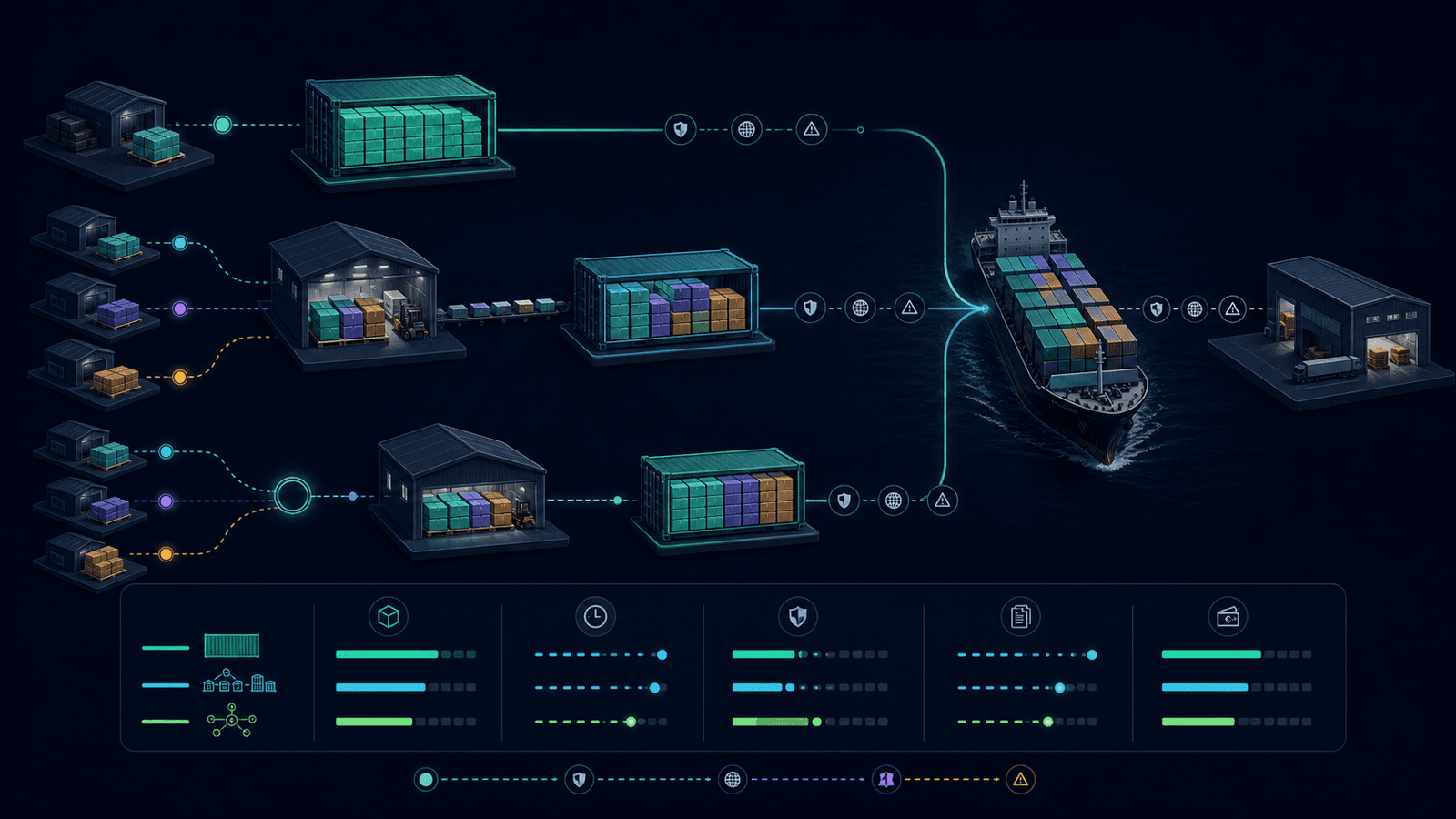
Audit verdict
The best mode is the one whose failure costs you can see and control
An SME should not ask whether FCL is cheaper than LCL in the abstract. It should ask which option produces the lowest risk-adjusted landed cost for a defined shipment policy. That policy includes how frequently purchase orders become ready, how long the business can wait to fill a box, whether cargo can share a container safely, who controls the origin handoff, and how a late or damaged shipment affects customers. The winner can change by season and even by purchase-order wave on the same lane.
The global backdrop makes false precision especially dangerous. UNCTAD reports that maritime trade volumes reached 12,720 million tons in 2024, up 2.2 percent, while rerouting caused ton-miles to grow 5.9 percent. Those are system-level measures, not SME rate or transit-time benchmarks, but they show why distance, routing, and disruption can change faster than a static sourcing spreadsheet expects. Around four-fifths of international goods trade by volume moves by sea, so an ocean-mode decision is a working-capital and customer-service decision as much as a freight decision.
A sound policy therefore has three layers. The commercial layer compares normalized quotes and cash timing. The operational layer audits handoffs, cutoffs, documentation, packing, and recovery paths. The governance layer defines who can select a mode, accept an exception, approve a consolidation hold, and validate a charge. SMEs building transportation and logistics systems should make those layers visible in one decision record rather than hiding them in inboxes and rate sheets.
The verdict of this audit is conditional. LCL is not merely a slow version of FCL, FCL is not automatically safer, and buyer consolidation is not free container utilization. Each is a service design with different failure surfaces. The goal is to expose those surfaces early enough that procurement, finance, customs, warehouses, suppliers, and forwarders can choose deliberately.
Evidence: unctad-rmt-series, unctad-rmt-2025, unctad-rmt-2025-ch1
Comparable definitions
FCL, LCL, and buyer consolidation solve different aggregation problems
In an FCL movement, the shipper or buyer books a container service for a dedicated load, even if the physical cube is not fully occupied. Dedicated does not necessarily mean one supplier, one commercial invoice, one customs line, or one risk owner; those depend on the transaction structure and documents. It means the booked container is not an ordinary shared LCL box assembled from unrelated consignees. The importer must still plan stuffing, weight distribution, sealing, drayage, equipment availability, free time, and unloading.
In LCL, a shipment occupies part of a consolidated container. The forwarder or NVOCC can receive individual consignments at an origin container freight station, combine them for ocean carriage, and deconsolidate at destination. That network lets an SME move smaller lots without buying a dedicated box. It also introduces CFS cutoffs, receiving rules, minimum charges, cargo compatibility decisions, deconsolidation steps, and local billing elements that do not appear in a simple per-CBM headline.
Buyer consolidation is a managed origin program that combines an individual buyer's orders from multiple suppliers into one or more dedicated FCL containers instead of treating every supplier order as a separate LCL movement. DHL's glossary and service material use that basic definition. The economic unit becomes the purchase-order wave and supplier network, not one shipment. The extra work includes supplier booking, pickup or delivery scheduling, receiving, discrepancy control, staging, packing plans, document orchestration, container loading, and overflow rules.
These definitions matter because superficial comparisons mix units. A shipment-level LCL quote cannot be compared fairly with a multi-supplier program fee unless the analyst allocates consolidation-center and coordination costs. Likewise, the apparent FCL price advantage disappears if a dedicated box waits for product that the business did not need to buy yet. The fair question is what service and inventory policy the SME is purchasing.
| Decision dimension | LCL | FCL | Buyer consolidation |
|---|---|---|---|
| Aggregation unit | One partial shipment joins unrelated cargo in a provider network | One dedicated container booking for the shipper or buyer's load | Multiple supplier orders for one buyer form planned dedicated-container waves |
| Typical origin work | CFS receiving, measurement, consolidation, and shared-container loading | Stuffing at supplier, warehouse, or nominated facility plus sealing and drayage | Supplier management, receiving, discrepancy control, staging, load planning, stuffing, and overflow handling |
| Typical destination work | Shared box deconsolidation, CFS release, shipment-level collection or delivery | Container pickup or delivery, stripping, empty return, and free-time control | Dedicated box handling plus order-level allocation and receipt across the buyer's network |
| Capacity purchase | Chargeable share subject to the quote's weight-and-measure rules and minimums | Container service regardless of unused physical space | Container service plus consolidation-program charges and possible overflow LCL |
| Primary flexibility | Smaller shipment releases without waiting to fill a dedicated container | Control over one container's load and fewer shared-network interfaces | Uses volume across suppliers without forcing each supplier to fill a box |
| Primary coordination risk | CFS cutoff, shared routing, local charge, and cargo compatibility | Underutilization, equipment, stuffing, drayage, free time, and inventory lot size | Late suppliers, mismatched documents, staging dwell, load-plan churn, and overflow |
| Best comparison unit | Door-to-door cost and elapsed-time distribution per shipment and SKU | Door-to-door container cost allocated by SKU, cube, weight, value, or handling rule | Program cost per purchase-order wave, container, supplier, SKU, and exception |
Evidence: dhl-buyer-consolidation, dhl-single-country-consolidation, fmc-oti, maersk-lcl-terms
Failure-mode method
Run an FMEA before negotiating another rate
A failure mode and effects analysis turns vague concerns into control decisions. For each mode, define the failure, its operational effect, likely cause, existing prevention, detection signal, accountable owner, and response. A team may score severity, occurrence, and detectability on a consistent internal scale, but the score is not an industry fact. It is a prioritization aid based on the SME's product value, customer promise, lane history, and control maturity.
Do not copy one generic risk-priority number across lanes. A two-day delay might be immaterial for replenishment stock and catastrophic for a launch. Moisture exposure might be manageable for rugged metal parts and unacceptable for untreated paper products. A destination CFS correction might be a small nuisance on a low-value order and erase margin on a dense, low-cube shipment. The effect belongs to the business context.
Use two reviews. The pre-award FMEA tests the service design and quotation. The monthly operating FMEA uses actual exception evidence: missed supplier appointments, remeasurements, rolled bookings, transshipments, customs document corrections, CFS dwell, damage, claims, detention, empty-return issues, and invoice disputes. The second review should change the routing policy when the observed distribution has moved, rather than explaining every miss as a one-off.
The table below is a failure catalogue, not a prediction that one mode will always perform worse. It deliberately names controls alongside exposures. A strong LCL operator can outperform a poorly managed FCL chain, and a disciplined buyer-consolidation program can remove fragmentation that individual FCL or LCL bookings would preserve.
| Failure mode and effect | LCL exposure | FCL exposure | Buyer-consolidation exposure | Early signal and practical control |
|---|---|---|---|---|
| Chargeable quantity exceeds plan; quote comparison breaks | CFS remeasurement or weight-and-measure rule changes billed units | Container rate is stable but overweight, special handling, or wrong equipment can add cost | Supplier data errors distort the shared load plan and overflow decision | Capture packed dimensions and gross weight by handling unit; reconcile booking, warehouse, and invoice measurements |
| Cargo misses origin cutoff; departure slips | Late CFS delivery can miss the consolidation window | Late stuffing, drayage, VGM, or documentation can miss terminal cutoff | One supplier can hold or reshape the wave unless a freeze rule exists | Use supplier-ready milestones, cutoff buffers, escalation clocks, and an approved split or overflow decision |
| Unexpected local charges erase apparent savings | Origin and destination CFS, minimums, release, handling, or storage may be material | Drayage, terminal, chassis or equipment, detention, demurrage, and empty return can be material | All FCL local exposure remains, plus hub receiving, staging, and program fees | Demand a charge dictionary, responsible party, unit, trigger, free time, cap where negotiable, and invoice evidence |
| Physical damage or contamination | Shared handling and co-loading create additional interfaces and compatibility questions | Fewer shared interfaces, but poor stuffing or securing can damage an entire dedicated load | Multiple suppliers create packaging and compatibility variation inside one dedicated box | Apply packaging specifications, compatibility matrix, pre-load inspection, load photos, seal control, and exception evidence |
| Customs or document hold | Shipment-level house documents and data corrections can delay release | Dedicated equipment does not cure incorrect classification, value, origin, permits, or party data | Multiple supplier invoices and origins create an orchestration problem, not automatic simplification | Create field-level ownership, pre-departure validation, broker review gates, and amendment procedures |
| Inventory arrives too early or too late | Small releases may reduce lot size but shared-network variability can shift receipt | Large lots can lower unit logistics cost while increasing cycle stock and cash tied up | Waiting to build a wave can delay ready orders; synchronized planning can also reduce fragmentation | Model cash-to-cash days, target inventory, service risk, and a maximum consolidation-hold policy |
| Route disruption or roll | Provider routing and co-load schedule can limit control | A dedicated booking still faces vessel, port, and transshipment disruption | A disrupted wave affects several suppliers and orders together | Record actual route, direct versus transshipment, alternatives, priority terms, and recovery decision rights |
| Visibility event is late or inconsistent | House shipment and shared equipment events may not align | Container events are clearer but may not expose supplier or order readiness | Supplier, purchase-order, shipment, transport, and equipment views must be joined | Define milestone semantics, source times, freshness, exception rules, and manual fallback rather than buying a dashboard alone |
| Capacity is wasted or unavailable | Small lots avoid dedicated unused cube but space can be constrained at peak periods | Poor packability or irregular demand leaves paid cube unused | Supplier lateness can create partial boxes or repeated overflow | Use a physical pack plan, demand bands, booking forecast, and a mode-switch rule before each wave |
| Provider failure or unclear legal role | The contractual carrier, forwarder, CFS, and subcontractors may be misunderstood | Carrier, forwarder, drayage, warehouse, and consignee responsibilities can fragment | The control-tower promise may obscure who issues documents and bears each obligation | Verify contracts, licenses or registrations where applicable, insurance, claims procedure, subcontracting, data rights, and exit support |
Evidence: unece-ctu-code, imo-vgm, fmc-oti, dcsa-track-trace, wco-data-model
Break-even discipline
Why a universal cubic-metre threshold is mathematically unsound
A threshold exists only after two cost functions have been defined. For a simplified LCL quote, the total may equal fixed shipment charges plus the quoted rate multiplied by chargeable weight-and-measure units, plus charges excluded from that rate. For FCL, the total may equal container linehaul plus origin, destination, drayage, equipment, documentation, stuffing, stripping, and realistic exception allowances. The crossover changes whenever a fixed charge, variable rate, routing, free-time assumption, or scope changes.
Cargo density can shift the LCL unit independently of physical cube. In the cited Maersk LCL terms, weight-and-measure units are based on gross volume in cubic metres or gross weight, whichever is higher, with one CBM equated to 1,000 kilograms for that agreement. Other providers, commodities, minimums, and markets can use different rating details. The analyst must copy the governing rule from the actual quotation and terms rather than turning one provider's clause into a global standard.
Packability also prevents a clean conversion from shipment CBM to container utilization. Carton dimensions, pallet footprints, non-stackability, crush limits, dunnage, load distribution, door opening, and weight can cause usable capacity to be lower than nominal internal volume. Hapag-Lloyd's specification illustrates a 20-foot general-purpose unit with about 33.2 cubic metres of internal capacity, while also showing container-specific dimensions and payloads. It is a specification example, not proof that 33.2 shipment CBM will fit or that a lower number is the economic switch point.
Finally, the denominator matters. A low FCL cost per shipped cubic metre can be a bad business decision if the SME buys six extra weeks of stock to fill the box. Conversely, an apparently expensive LCL shipment can protect margin when it prevents a stockout or avoids obsolete inventory. Break-even must compare the same demand service, not just the same kilograms and cubes.
Evidence: maersk-lcl-terms, hapag-container-spec
Quotation audit
Normalize the boundary before comparing the numbers
Most bad mode comparisons begin with mismatched scope. One quotation starts at a supplier's door, another at an origin CFS, and a third at the port terminal. One includes destination delivery; another ends before release charges. One uses current spot exchange rates while another carries a floating currency adjustment. The spreadsheet may look precise while comparing three different products.
Create a quote-normalization ledger with one row per charge family and one column per mode. Record the charge name from the provider, your standardized definition, currency, conversion date, billing unit, minimum, included quantity, payer, trigger, validity, taxes if relevant, and evidence needed to approve the invoice. Ask providers to confirm ambiguous inclusions in writing. A blank should mean unknown, not zero.
Separate controllable baseline charges from contingent exposure. Baseline includes amounts expected if the shipment executes to plan. Contingent exposure includes storage after free time, remeasurement, amendment, failed delivery, customs exam support, chassis or equipment extensions, demurrage or detention where applicable, and urgent recovery. Do not assign a universal probability. Use the SME's lane history, provider terms, and operational design, then show a low, base, and high outcome.
The normalized quote should also preserve commercial validity. The Shanghai Shipping Exchange describes SCFI as an index of Shanghai export spot ocean freight and related seaborne surcharges across defined base-port routes. Its methodology is useful market context, but it is not an SME's complete door-to-door LCL or FCL quotation. The exchange's own older explanatory page explicitly distinguishes items not included in that index, reinforcing why a public index cannot substitute for local-charge diligence.
| Cost or term family | LCL questions | FCL questions | Buyer-consolidation questions |
|---|---|---|---|
| Origin pickup and receiving | Pickup zone, appointment, CFS receiving, minimums, pallet or loose handling, remeasurement | Drayage, empty pickup, live or drop stuffing, waiting, chassis or equipment, terminal delivery | Supplier pickups, milk run or direct delivery, hub receiving, discrepancy, labels, storage, and rejected freight |
| Main carriage | WM or CBM basis, minimum, routing, direct or transshipment, surcharges, allocation | Container type, linehaul, routing, surcharges, allocation, equipment substitution | FCL carriage plus program volume commitment and overflow pricing |
| Documentation | House bill, amendment, manifest, security filing support, release and courier if any | Carrier or house bill, VGM data, amendment, seal and release | Supplier document collection, purchase-order mapping, consolidation instruction, house-document architecture |
| Destination | Deconsolidation, CFS, handling, minimums, storage clock, release, delivery, appointment | Terminal, container delivery or pickup, stripping, chassis or equipment, empty return, free time | FCL destination exposure plus order allocation, cross-dock, multi-drop, or receiving support |
| Exceptions | Non-stackable, overlength, high density, dangerous or restricted goods, rework, customs exam | Overweight, wrong equipment, late return, failed delivery, exam, special stow or reefer support | Late supplier, short or excess quantity, incompatible cargo, repack, wave hold, partial load, overflow |
| Commercial terms | Validity, currency, credit, cancellation, claims, liability, subcontracting | Validity, free time, capacity, cancellation, no-show, claims, liability | Program fee, implementation fee, minimum volume, gainshare if any, data rights, exit and inventory disposition |
Evidence: sse-scfi-methodology, sse-scfi-faq
Chargeable volume
Measure the handling unit that will actually be rated
Procurement data often stores product dimensions, while freight is rated on the packed handling unit. Ten cartons on a pallet occupy the pallet's maximum length and width and the loaded height, including overhang, protective corners, and top boards. A non-stackable pallet can consume economic space beyond its geometric cube. If the booking uses estimated loose-carton dimensions and the CFS receives wrapped pallets, a remeasurement should not be surprising.
Build a measurement control at packing or supplier dispatch. Capture gross weight, length, width, height, package count, packaging type, stackability, orientation constraints, and measurement method. Tie the record to purchase orders and supplier item revisions. Photograph the measured unit with an identifier where the process and privacy rules allow. Reconcile the supplier declaration, forwarder booking, CFS receipt, and invoice quantity.
Do not optimize only the number. Packaging changes can reduce chargeable volume while increasing damage or compliance risk. Removing dunnage, stacking beyond carton strength, or creating unstable mixed pallets may save a freight unit and lose an order. The CTU Code treats planning, cargo compatibility, tight or secured stow, and moisture exposure as safety and integrity matters across the intermodal chain. Economic packing and safe packing are the same design problem.
A practical control is a chargeable-unit variance threshold chosen by the business. When received WMU differs from booked WMU, route the difference to an owner before accepting a repeatable surcharge. Determine whether the cause is supplier master data, palletization, CFS measurement, provider rule, or booking error. The threshold is a workflow trigger, not a claim that small variances are always wrong.
Evidence: maersk-lcl-terms, unece-ctu-code
Container utilization
Nominal cube is a ceiling, not a load plan
A container's published internal dimensions describe available geometry under specified equipment examples. Cargo arrives as discrete units with doors, floors, walls, load limits, balance constraints, and handling access. A product can cube out before it weighs out, weigh out before it cubes out, or fail to fit because two pallet footprints leave unusable channels. The only defensible utilization forecast is based on packed dimensions, stacking rules, equipment specifications, and a reproducible loading method.
Calculate three utilization views. Geometric utilization is packed cargo volume divided by the equipment's nominal internal volume. Planned usable utilization is the share of positions or layers the approved pack plan actually occupies. Economic utilization is the value or service output obtained per container after considering inventory and exceptions. A high geometric percentage can still be bad if unloading is unsafe, product families are mixed incorrectly, or one delayed purchase order holds the whole wave.
Weight requires equal attention. Verify cargo gross mass, packaging and securing material, container tare, payload, axle and road constraints, terminal requirements, and any commodity-specific restrictions with the responsible providers and authorities. Under SOLAS, verified gross mass is a condition of loading a packed container onto a covered ship. The IMO states that the shipper named on the bill of lading or sea waybill is responsible for providing VGM under the rule; the contract and workflow must identify who calculates, submits, validates, and corrects it.
Before approving FCL, simulate the load with real handling units and test a practical strip plan at destination. Before approving buyer consolidation, run the same simulation across supplier variability and define a load-plan freeze time. When a late order would force unsafe loading or create a missed cutoff, the system should choose a pre-approved alternative rather than relying on warehouse improvisation.
Evidence: hapag-container-spec, imo-vgm, unece-ctu-code
Origin failure modes
The first missed handoff often decides the entire transit
LCL depends on a cargo-ready date that leaves enough time for pickup, CFS receiving, security or regulatory steps, measurement, consolidation, and documentation before cutoff. A sailing may be frequent while the relevant consolidation closes less frequently or earlier than expected. Ask for the operational schedule that applies to the origin CFS and service, not simply the carrier's advertised vessel frequency.
FCL replaces the shared CFS interface with its own origin chain. Equipment must be available, an empty may need collection, the stuffing site must be ready, cargo must fit, VGM and documents must arrive, and drayage must reach the terminal. A supplier that says cargo is ready may mean production is complete, not that export packing, inspection, labeling, and paperwork are complete. Define ready-to-pick, ready-to-stuff, and customs-ready separately.
Buyer consolidation magnifies the need for milestone discipline. Each supplier needs a booking acknowledgement, confirmed quantities, pack data, collection or delivery appointment, document set, and discrepancy response. The program should freeze the wave at a stated time. A late supplier should not automatically make every on-time supplier late. The approved choice might be next wave, overflow LCL, a partially utilized box, or a service exception, depending on the commercial impact.
Measure origin dwell by state rather than one total. Separate time awaiting supplier cargo, awaiting documents, awaiting consolidation decision, awaiting equipment, and awaiting departure. This turns delay into an accountable queue. It also prevents a buyer-consolidation provider from reporting that the box departed on time while ignoring ten days spent accumulating cargo that was already paid for.
Evidence: dhl-single-country-consolidation, imo-vgm
Destination failure modes
Destination handling can reverse the apparent mode advantage
LCL cargo normally must be deconsolidated and released at destination before final collection or delivery. The shipment can be affected by master-container arrival, CFS availability, document release, customs status, local operating hours, appointments, and storage rules. An SME should obtain the expected release sequence, charging units, free periods if any, and dispute evidence in writing for the specific service and destination.
FCL avoids ordinary LCL deconsolidation but creates a container clock. The consignee may need terminal pickup, chassis or equipment, delivery appointment, unloading capacity, and an empty-return location within the applicable terms. A warehouse that can receive eight pallets through a dock door may not be able to strip a floor-loaded container promptly. The mode decision must include site capacity and weekend or holiday calendars.
Buyer consolidation can simplify destination flow when a dedicated box moves to one controlled facility, but only if order allocation and receiving data are ready. If the buyer needs multiple destination drops, cross-docking, or immediate purchase-order visibility, those services must be designed and priced. A single container can concentrate disruption: one hold or unavailable appointment affects many supplier orders at once.
Track the full distribution of availability-to-receipt time, not just vessel arrival. The World Bank's 2023 Logistics Performance Index evaluates six dimensions, including customs efficiency, infrastructure, shipment pricing, logistics service quality, tracking and tracing, and timeliness. Its 4,090 professional assessments across 139 countries illustrate how logistics conditions vary; they do not provide a substitute for the SME's CFS, terminal, broker, and warehouse event history on a specific lane.
Evidence: world-bank-lpi-2023
Cargo integrity
Count handling interfaces, then design packaging for the actual chain
It is reasonable to map additional physical interfaces, but it is not factual to declare that every LCL shipment has a higher damage rate than every FCL shipment. LCL can involve supplier loading, pickup transfer, origin CFS receiving, consolidation, destination deconsolidation, and final delivery. FCL can reduce shared handling yet expose an entire order to poor blocking, lashing, moisture control, uneven weight, forklift damage, or an unsafe strip. Buyer consolidation adds receiving and staging across suppliers before dedicated loading.
The joint IMO, ILO, and UNECE CTU Code is a non-mandatory global code of practice covering packing and handling across sea and land transport. It identifies poor packing, inadequate securing, overloading, and incorrect declaration as important concerns and provides guidance for packers, receivers, and unpackers. Use it as a control reference while also following mandatory rules, carrier requirements, product standards, insurance terms, and qualified packaging advice applicable to the shipment.
Create a packaging matrix by SKU and route. It should specify primary and transport packaging, pallet pattern, stack limit, edge and top protection, moisture and contamination controls, compatibility restrictions, lifting points, labels, and inspection evidence. Buyer consolidation needs a common minimum across suppliers; one weak package can fail under the loading and handling profile of the whole program. LCL needs the provider to know non-stackable, fragile, hazardous, odorous, leaking, high-value, or incompatible characteristics before acceptance.
Claims readiness belongs in the design. Record custody times, quantities, condition photos, seal numbers where relevant, packing evidence, exceptions at receipt, delivery records, and notice deadlines. Establish who inspects, mitigates, notifies, preserves evidence, and communicates with the customer. Freight mode does not replace cargo insurance analysis, and a low declared liability ceiling should not be mistaken for full recovery.
Evidence: unece-ctu-code
Routing and frequency
More sailings do not automatically mean a more predictable receipt
Advertised frequency is only one clock. LCL has a CFS receiving and consolidation calendar before ocean departure and a deconsolidation calendar after arrival. FCL has equipment, terminal, and documentation cutoffs. Buyer consolidation has a supplier accumulation cycle before the FCL chain begins. Compare cargo-ready-to-receipt distributions, not port-to-port schedules alone.
Ask whether the service is direct or transshipped, which ports and facilities are planned, how often the co-load departs, how rollovers are prioritized, and what alternative is available after a miss. A weekly direct service can outperform a more frequent itinerary with fragile connections; the opposite can also be true when direct capacity is constrained. Historical averages should be segmented by routing and season rather than blended into one promise.
UNCTAD's Liner Shipping Connectivity Index measures an economy's position in liner networks using ship calls, container-handling capacity, number of services and companies, largest ship size, and direct country connections. It is useful for comparing structural connectivity and observing change. It is not a forecast that a particular shipment will sail or arrive on time, and it does not capture the buyer-consolidation wait before a container enters the network.
Use public data at the right layer. SCFI tracks defined Shanghai export spot ocean freight markets and seaborne surcharges, while UNCTAD connectivity data describes network position. UN Comtrade can help profile officially reported historical trade by product and partner, but reported datasets can be updated or revised and they do not provide an operational freight quote. None of these sources contains the SME's supplier readiness, CFS workflow, negotiated local charges, free time, or warehouse calendar. Market data should trigger a quote refresh or scenario review, not overwrite the booking evidence.
Evidence: unctad-lsci, sse-scfi-methodology, un-comtrade
Customs and documents
Consolidating freight does not consolidate legal facts
A dedicated container can carry goods from multiple suppliers, origins, classifications, values, and regulatory regimes. Buyer consolidation does not make those facts one item, and one master movement does not automatically create one simple customs declaration. The importer and broker need the country-specific line data, invoices, packing details, origin evidence, licenses or permits, parties, and transport documents required for the actual entry structure.
Build a document-to-data map. For each field, name the system of record, supplier, internal owner, validation, due time, and amendment path. The WCO Data Model provides harmonized and reusable data definitions and electronic messages for Customs and other cross-border regulatory agencies. It is a useful reference for reducing conflicting meanings across invoice, packing list, bill of lading, and internal purchase-order data, but implementation must still match each jurisdiction's requirements.
In the United States, CBP's importing guide explains the importer's reasonable-care expectation and makes clear that its checklist is advisory rather than binding or exhaustive. The principle is useful beyond the narrow question of mode: hiring a broker or forwarder does not justify sending incomplete product facts and treating the resulting declaration as someone else's problem. Other countries have their own laws and roles, so an SME should obtain jurisdiction-specific advice.
Provider roles also matter. The U.S. Federal Maritime Commission distinguishes ocean freight forwarders from NVOCCs: an NVOCC holds itself out as a carrier, issues its own house bill or equivalent, and does not operate the vessel, while an ocean freight forwarder arranges movement and processes documents for shippers. These are U.S.-trade definitions and requirements, not a universal taxonomy. The buyer should verify the actual contracting party, issued documents, licensing or registration where applicable, financial responsibility, and claims route.
Evidence: wco-data-model, cbp-import-guide, fmc-oti
Incoterms responsibilities
Select the transport mode and the sales rule as connected but separate decisions
Incoterms rules allocate specified delivery, cost, risk, and obligation responsibilities between seller and buyer under the sales contract. They do not choose FCL or LCL, calculate customs value, transfer title by themselves, or replace the contracts of carriage, insurance, payment, and finance. Write the selected rule with a precise named place and the version, then map the operational handoff to the freight design.
ICC states that Incoterms 2020 contains 11 trade terms. Its official checklist directs users toward FCA when goods travel in containers or multimodal transport or are delivered to an inland or port terminal, while preserving FOB for specified onboard-delivery contexts such as general or bulk cargo loaded directly aboard or other deliberate reasons. This is a reason to review casual FOB usage for containers, not a blanket legal conclusion for every sale.
Buyer consolidation can expose inconsistent supplier terms. One supplier may deliver to the consolidation center under FCA at a named place, another may quote an origin-paid arrangement, and a third may leave export clearance or pickup uncertain. If the buyer's forwarder is expected to control pickups and the supplier contract does not support that handoff, late fees and document gaps follow. Create a supplier-by-supplier responsibility matrix for pickup, export formalities, packaging, loading, documents, risk, and cost.
The mode worksheet should show who pays and who acts at every leg, but it must not infer risk transfer only from an invoice charge. A seller can pay a cost after risk has transferred under some structures, and commercial parties can create obligations outside the selected rule. Qualified legal and trade professionals should review the actual contract and jurisdiction when exposure is material.
Evidence: icc-incoterms-2020, icc-incoterms-checklist
Inventory and cash
Freight savings can be purchased with too much inventory
FCL tends to encourage a larger shipping lot when one supplier or purchase-order stream must fill the container. That can reduce logistics cost per shipped unit while increasing average inventory, cash committed before sale, storage, insurance, handling, markdown, and obsolescence exposure. LCL can support smaller, more frequent replenishment, but fixed charges and shared-network variability can be costly. Buyer consolidation can combine supplier demand without enlarging every supplier's order, yet ready cargo may wait for the wave.
Model the cash timeline from supplier deposit or payment through customer collection. Capture days between order, production readiness, consolidation receipt, departure, arrival, customs release, warehouse receipt, sale, and collection. The freight decision changes cash in transit and cycle stock even when unit purchase price is identical. Finance should supply the annual carrying-rate input and explain what it includes; no public percentage is universally appropriate.
A transparent carrying estimate can start with average inventory value multiplied by the company's annual carrying rate and incremental days divided by 365. Keep it separate from freight so the team can see why the winner changes. Add expected shortage or launch-delay impact as a scenario, not as a certain saving. If a consequence is hard to monetize, report days, orders, and service risk rather than inventing an ROI.
Buyer consolidation needs a maximum-hold rule. The provider should not wait indefinitely for utilization while the buyer accumulates working capital and customer risk. The rule can consider order priority, fill percentage from the physical pack plan, next sailing, overflow price, inventory position, and supplier certainty. A named decision owner should approve exceptions with the expected cash and service effect visible.
Evidence: unctad-rmt-2025
Supplier orchestration
Buyer consolidation is a control-tower process in miniature
The value proposition is compelling: use volume from several suppliers to form dedicated FCL loads for one buyer. The hidden condition is synchronized execution. Every supplier must understand how to book, label, pack, measure, document, and deliver; the consolidator must receive and reconcile; the buyer must decide what joins each wave. Without that operating system, the program becomes a warehouse full of exceptions.
Start with a supplier-readiness segmentation. Group suppliers by shipment frequency, data quality, packaging conformance, pickup geography, Incoterm, export-document readiness, lead-time reliability, and commodity compatibility. A supplier with sporadic fragile cargo on a distant pickup route may not belong in the first wave even if its volume improves theoretical cube. Design the pilot around compatible, repeatable flows rather than the largest supplier count.
Define a purchase-order control record containing supplier, origin, ready window, cartons or pallets, gross weight, dimensions, stackability, product restrictions, documents, destination need date, and priority. The consolidator should report received quantity and condition against that record. Short, excess, damaged, or unlabeled cargo should enter an exception queue with a response clock; it should not silently modify the load plan.
Govern the load freeze and overflow. Before freeze, approved orders may enter based on rules. At freeze, the buyer accepts the load plan and remaining orders follow a predetermined path. After freeze, changes require explicit approval because they can alter VGM, documents, customs data, stow, cutoff, and customer allocation. This discipline is what turns consolidation from a forwarding feature into a repeatable supply-chain operation.
Evidence: dhl-buyer-consolidation, dhl-single-country-consolidation, imo-vgm, unece-ctu-code
Transparent calculator
Solve the crossover from actual quotes, then stress it
Use three equations with the same service boundary. LCL total equals fixed LCL charges plus the applicable chargeable units multiplied by the complete variable rate, plus separately quoted accessorial and risk scenarios. FCL total equals the dedicated-container baseline plus origin, destination, drayage, equipment, documentation, stuffing or stripping, and scenario exposure. Buyer-consolidation total equals its FCL total plus supplier pickups, hub receiving, staging, program management, and expected overflow, allocated across the orders using a declared rule.
The following example uses fictional currency units, not a market quotation. Assume one lane and date, general stackable cargo, no dangerous-goods or special handling, identical duties and product cost, and a common origin-to-warehouse boundary. LCL has 520 CU of fixed charges and 165 CU per quoted WMU. FCL totals 4,200 CU under the scenario after included origin and destination items. Buyer consolidation totals 4,650 CU for the wave before order-level inventory effects. These numbers exist only to show the mechanics.
On those assumptions, the simplified LCL-versus-FCL arithmetic crossover is about 22.3 WMU: (4,200 minus 520) divided by 165. That is not the utilization at which cargo fits, the amount an SME should ship, or a transferable benchmark. It disappears when the quote inputs change. If the cargo weighs 18 tonnes at 12 cubic metres under the cited example's one-tonne-per-WMU convention, the chargeable input would be driven by weight; if the actual quote uses another rule, the calculation must follow that rule.
The table deliberately keeps inventory and disruption outside the base freight totals. Add them as visible scenarios afterward. This prevents a buyer from hiding a working-capital penalty inside a freight estimate or claiming that a speculative stockout saving is a confirmed transportation benefit.
| Shipment or wave input | Illustrative LCL total | Illustrative FCL total | Illustrative buyer-consolidation total | What the result does not prove |
|---|---|---|---|---|
| 8 WMU | 520 + 165 × 8 = 1,840 CU | 4,200 CU | 4,650 CU | LCL wins this simplified freight view, but service, damage, and local-charge scenarios still require review |
| 14 WMU | 520 + 165 × 14 = 2,830 CU | 4,200 CU | 4,650 CU | The gap is quote-specific and says nothing about whether one supplier should buy more stock |
| 20 WMU | 520 + 165 × 20 = 3,820 CU | 4,200 CU | 4,650 CU | FCL is close in the illustration, not universally better above 20 WMU |
| 22.3 WMU | Approximately 4,200 CU | 4,200 CU | 4,650 CU | This is only the algebraic crossover under the stated fixed and variable assumptions |
| 26 WMU | 520 + 165 × 26 = 4,810 CU | 4,200 CU | 4,650 CU | FCL appears lower before inventory, fit, free-time, and exception effects |
| 26 WMU from several suppliers | Separate LCL shipments require their own fixed and variable quotes | A direct single-supplier FCL may not be operationally available | 4,650 CU plus any overflow or holding scenario | Buyer consolidation must be compared with the real alternative purchase-order pattern, not one imaginary shipment |
Evidence: maersk-lcl-terms, hapag-container-spec
Sensitivity bands
A range is more decision-useful than a false point estimate
Stress the illustrative equation instead of worshipping 22.3. Holding the fictional 520 CU LCL fixed amount constant, an LCL variable rate of 130 to 210 CU per WMU and an FCL total of 3,600 to 4,800 CU produces crossovers ranging from roughly 14.7 to 32.9 WMU. Those endpoints are arithmetic from invented scenario bounds, not observed market bands. Their purpose is to show how readily a threshold moves.
Next, vary the operating inputs. Add a supplier-miss scenario to buyer consolidation, an LCL remeasurement scenario, an FCL free-time overrun, a transshipment delay, a customs document correction, and a cargo-damage event with appropriately bounded consequences. Avoid summing every worst case into a single fear number. Report each scenario, its cause, and its prevention separately so management can choose which risks to control or accept.
Define scaling thresholds in operational terms. A company may review the mode when rolling eight-week volume, supplier count, chargeable density, load-plan utilization, overflow frequency, CFS dwell, or destination-charge variance crosses a business-set limit. The threshold should trigger a new quote and pack plan, not automatically switch every booking. A temporary peak should not create a permanent purchasing policy.
Recalibrate on evidence. If buyer consolidation repeatedly holds ready cargo, its utilization metric is masking a service problem. If LCL invoices repeatedly exceed normalized quotes, resolve rating and local-charge causes before negotiating the headline rate. If FCL boxes depart underfilled because demand is irregular, consider a smaller lot policy, a consolidation program, or planned LCL releases rather than blaming the warehouse.
| FCL scenario total | LCL variable 130 CU/WMU | LCL variable 165 CU/WMU | LCL variable 210 CU/WMU |
|---|---|---|---|
| 3,600 CU | 23.7 WMU | 18.7 WMU | 14.7 WMU |
| 4,200 CU | 28.3 WMU | 22.3 WMU | 17.5 WMU |
| 4,800 CU | 32.9 WMU | 25.9 WMU | 20.4 WMU |
| Interpretation | Lower variable LCL cost pushes the arithmetic crossover higher | Base illustration, not a recommendation | Higher variable LCL cost pushes the arithmetic crossover lower |
Predictability and visibility
A milestone is useful only when its meaning and clock are controlled
Visibility is not a map with a moving dot. The buyer needs event definitions that support a decision: supplier confirmed, cargo ready, pickup completed, CFS received, discrepancy open, wave frozen, container stuffed, VGM submitted, gated in, loaded, departed, transshipped, discharged, customs released, available, delivered, stripped, and empty returned as applicable. Each event needs an object, source, source time, received time, status, and exception rule.
DCSA's Track and Trace standard documentation covers five general shipment phases: pre-shipment, pre-ocean, ocean, post-ocean, and post-shipment. Its common shipment, transport, and equipment event approach can reduce carrier-interface inconsistency. Adoption does not automatically create supplier readiness, house-level LCL visibility, customs release, or buyer purchase-order allocation; the SME must map provider data to its own objects and decisions.
LCL needs a relationship between the house shipment and the shared equipment movement. FCL needs container, booking, purchase order, and warehouse receipt linked. Buyer consolidation adds supplier order, hub receipt, wave, and overflow. A status copied from a carrier portal can be technically accurate and operationally misleading if it refers to the master box while the buyer's shipment is held at a CFS or lacks release data.
Set freshness and fallback standards. If an event is expected by a cutoff and absent, create an exception rather than waiting for the dashboard. Preserve manual confirmations with source and time. Measure completeness, latency, correction frequency, and decision usefulness by provider and milestone. A data-management program should retain lineage so teams can distinguish a late physical move from a late electronic update.
Evidence: dcsa-track-trace, wco-data-model
Provider diligence
Buy the exception system, not only the happy-path rate
A provider demonstration should use the SME's awkward shipment, not a perfect container. Give candidates a fictional but representative set with a late supplier, non-stackable pallet, document amendment, dense cargo, weekend arrival, and destination appointment constraint. Ask them to build the booking, quote, milestones, invoice evidence, and recovery path. The exercise reveals handoffs that a sales deck hides.
For LCL, inspect origin and destination CFS identity, measurement process, co-load frequency, routing, cargo acceptance, storage clocks, house-document process, claims, and local-charge governance. For FCL, inspect equipment, drayage, stuffing model, VGM, terminal cutoffs, free-time information, empty return, appointment recovery, and exception authority. For buyer consolidation, add supplier onboarding, hub controls, inventory custody, load-plan freeze, discrepancy workflow, PO visibility, overflow, and exit support.
Verify regulatory status in the jurisdictions and trades involved. The FMC provides current resources for U.S. OTI licensing, registration, financial responsibility, tariffs, and role definitions. Do not assume a globally recognizable brand name resolves the contracting entity or subcontractor chain. Obtain the legal name, role, contract, applicable terms, insurance evidence, liability limits, claim process, data-processing terms, business continuity, and escalation contacts.
References should include comparable lanes and operating models, not only large multinational accounts. Ask for invoice-accuracy measures, event completeness, cargo-availability distributions, supplier exception counts, and claim-cycle evidence with definitions. Refusal to provide customer-confidential data is reasonable; refusal to define how performance would be measured is a control concern.
- Commercial: complete charge dictionary, rate validity, currency, minimums, surcharges, free time, cancellation, commitments, and audit evidence.
- Operational: named facilities, schedules, routing, cutoffs, capacity, equipment, cargo restrictions, packaging standards, receiving, delivery, and recovery.
- Customs and documents: role boundaries, data fields, deadlines, amendment, filing support, record retention, and escalation to qualified specialists.
- Cargo integrity: custody, inspection, compatibility, load evidence, seals, claims notice, mitigation, liability, and insurance coordination.
- Technology: event definitions, APIs or files, lineage, latency, correction, access control, security incident process, export, and continuity.
- Governance: accountable service owner, subcontractors, jurisdictional status, performance review, corrective action, change notice, and termination support.
Evidence: fmc-oti, dcsa-track-trace, unece-ctu-code
Implementation sequence
Pilot one lane and one purchase-order policy before scaling
The pilot should compare operating models on the same decision boundary. Choose a lane with meaningful but manageable volume, compatible products, accessible supplier data, and a destination team willing to record actual events and costs. Avoid selecting the smoothest lane merely to prove the preferred answer. The purpose is to learn where the service design fails.
Keep a control group or counterfactual where practical. Historical comparison can be distorted by season, market, and demand changes, so match periods and shipments carefully. Record why each shipment used a mode, not just what mode it used. Otherwise, urgent and difficult orders assigned to LCL may make LCL look inherently worse while routine replenishment assigned to FCL looks inherently better.
Set exit gates before launch. A buyer-consolidation pilot should pause if supplier exceptions, unidentified inventory, or hold days exceed business-set tolerances. An LCL test should pause for unresolved local-charge or damage-control failures. An FCL test should pause for unsafe loading, unmanageable free-time exposure, or inventory consequences. Gates protect the business from turning a pilot into an uncontrolled default.
A small SME does not need a giant platform to begin. It needs controlled definitions, a normalized ledger, consistent identifiers, a decision owner, and evidence. A spreadsheet can prove the operating model; custom software becomes valuable when volume, supplier complexity, events, permissions, and integration make manual control unreliable.
- Define the decision boundary
Name origin pickup point, destination receipt point, products, container options, service period, demand promise, and costs that are included or deliberately excluded.
- Reconstruct twelve months of evidence
Collect shipment, purchase-order, quote, invoice, measurement, event, customs-release, damage, claim, inventory, and customer-service records; label gaps instead of filling them with assumptions.
- Map the three operating models
Draw supplier, forwarder or NVOCC, CFS, carrier, terminal, broker, drayage, warehouse, and finance handoffs for LCL, FCL, and buyer consolidation.
- Build the FMEA and responsibility matrix
Assign each failure a cause, effect, prevention, detection, owner, response, and internally defined priority; connect Incoterm and contract responsibilities to real tasks.
- Normalize live quotations
Obtain written quotes for the same boundary and date, capture chargeable-unit rules and exclusions, and model low, base, and high contingent exposures.
- Prove physical and data readiness
Measure packed units, simulate loading, validate supplier documents, test milestone mappings, and verify destination receiving and empty-return capability.
- Run controlled waves
Use a predeclared mode policy, preserve reasons for exceptions, enforce freeze and overflow rules, and capture actual source-time events and invoice evidence.
- Adjudicate and scale conditionally
Compare cost, elapsed-time distributions, working capital, damage, invoice variance, supplier exceptions, and workload; scale only the lanes and cohorts that pass the defined gates.
Evidence: icc-incoterms-checklist, wco-data-model, dcsa-track-trace, unece-ctu-code
Exception remediation
When a mode fails, fix the cause before changing the label
A missed LCL departure does not automatically prove the shipment should have been FCL. Determine whether cargo missed CFS cutoff, the co-load schedule changed, documentation was incomplete, capacity rolled, or the planned connection failed. Remedies differ: earlier supplier readiness, another CFS, a direct service, a later customer promise, or a different mode may each be correct.
An underfilled FCL does not automatically prove the shipment should have been LCL. The cause might be forecast error, supplier delay, product allocation, carton geometry, or an overly rigid purchase-order rule. Requote LCL using actual handling units, then compare inventory and service impact. If FCL remains the robust option, improve the pack or order policy rather than forcing visual fullness.
A buyer-consolidation backlog is usually a policy signal. Separate cargo waiting for a planned wave from cargo waiting because of missing documents, discrepancies, incompatible freight, or indecision. Apply a maximum hold, quarantine inventory that cannot progress, and execute the overflow rule. The provider should never hide order-level aging behind a healthy container-utilization percentage.
Invoice disputes should feed routing governance. Map the disputed line to the quote, trigger, event, payer, and evidence. Resolve terminology differences and update the charge dictionary. If a charge is valid but recurring, add it to the baseline; if preventable, assign corrective action; if unsupported, follow the contract dispute path. Savings reported without invoice reconciliation are not realized savings.
| Observed failure | First diagnostic | Near-term containment | Systemic remediation |
|---|---|---|---|
| LCL cost exceeds quote | Reconcile booked and received WMU, minimums, local charges, currency, and excluded services | Hold or code disputed lines and protect cargo release under the contract | Repair measurements, quote scope, charge dictionary, approval, and provider terms |
| FCL misses terminal cutoff | Check cargo readiness, stuffing, equipment, drayage, VGM, documents, and terminal times | Rebook, secure storage, notify customers, and control added charges | Create milestone buffers, appointment ownership, alternate drayage, and document gates |
| Buyer-consolidation wave waits | Identify late supplier, missing data, discrepancy, incompatibility, or utilization decision | Freeze on-time cargo and apply approved partial-load or overflow rule | Segment suppliers, enforce SLAs, redesign wave frequency, and set maximum hold |
| Damage at receipt | Preserve condition, custody, packaging, load, seal, and delivery evidence | Mitigate further loss, notify required parties, and segregate affected goods | Redesign packaging, compatibility, loading, handling instructions, and claims workflow |
| Customs release delayed | Find the missing or inconsistent classification, value, origin, permit, party, or transport data | Escalate to qualified broker or adviser and correct through the proper procedure | Add field ownership, pre-departure validation, change control, and jurisdiction-specific review |
| Inventory benefit disappears | Compare planned and actual order, hold, transit, receipt, sale, and collection days | Adjust next release and customer allocation without assuming expedited freight | Reset lot policy, wave cadence, service stock, and finance inputs |
Evidence: imo-vgm, wco-data-model, unece-ctu-code
Decision scorecard
Make the mode policy conditional, reviewable, and reversible
A final scorecard should not collapse everything into freight cost per CBM. Show normalized transport cost, invoice variance, cargo-ready-to-receipt percentiles, inventory days, cash-in-transit days, supplier exception rate, damage and claim evidence, customs-document correction rate, internal workload, and customer-service impact. Define each metric and its data coverage. An average without the tail can hide the failure the business cares about.
Segment the policy. Stable, dense, compatible replenishment may use FCL. Small urgent releases may use LCL. Several nearby suppliers with reliable data may join buyer consolidation. New suppliers or new products may begin in a higher-control route until pack and document quality is known. The same SME can use all three without inconsistency because each serves a different demand and risk cohort.
Give the planner a decision tree. First ask whether cargo facts and documents are complete. Then determine whether the shipment must move before a viable consolidation or container window. Next compare actual chargeable units and physical fit. Test supplier coordination and destination capacity. Finally run normalized cost and inventory scenarios. Any failed control gate should route to an exception owner, not a silent default.
Review the policy on a calendar and on trigger events: material rate changes, new surcharges, routing changes, repeated rolls, supplier additions, product packaging changes, new regulations, warehouse changes, repeated invoice variance, or altered demand. The durable advantage is not choosing the perfect mode once. It is building a decision system that notices when the previous answer has stopped being true.
- Use LCL as a deliberate small-lot policy, not a leftover category for shipments that missed planning.
- Use FCL as a dedicated equipment and inventory policy, not a visual test of whether the box looks full.
- Use buyer consolidation as a governed supplier program, not a forwarding add-on assumed to create free utilization.
- Publish mode reasons and exceptions so later performance analysis is not distorted by selection bias.
- Retain a reversible fallback and re-quote trigger for every lane.
FAQ
At how many cubic metres is FCL cheaper than LCL?
There is no universal number. Solve the crossover from current quotes for one origin, destination, date, container, routing, service boundary, cargo density, and local-charge scope. Then test physical packability, inventory days, cash tied up, free-time exposure, and delay scenarios. A threshold copied from another lane or provider can be materially wrong.
Is LCL always slower than FCL?
No. LCL adds origin consolidation and destination deconsolidation processes, but an LCL service may depart sooner than an SME can fill or prepare an FCL. FCL can also roll, transship, wait for equipment, miss terminal cutoff, or encounter destination constraints. Compare cargo-ready-to-warehouse-receipt distributions for the actual services rather than labels.
Does LCL always have more cargo damage?
It can involve more handling and shared-cargo interfaces, but a universal damage-rate claim is not defensible. Packaging, compatibility, CFS practice, loading, securing, moisture, custody, and destination handling matter. FCL can suffer severe loss when an entire dedicated load is packed or secured poorly. Audit interfaces and use shipment-specific evidence.
What is buyer consolidation, and when does it work for an SME?
Buyer consolidation combines one buyer's orders from multiple suppliers into planned dedicated FCL containers instead of moving each order as separate LCL. It works when suppliers can meet shared booking, data, packing, labeling, delivery, and document standards and when volume and cadence support repeatable waves without excessive holding or overflow.
Can several suppliers and commercial invoices travel in one FCL container?
Operationally, dedicated containers can hold multiple suppliers' goods, but the transport and customs document architecture must be designed for the jurisdictions, parties, commodities, origins, values, and entry process involved. Consolidation does not merge distinct legal facts. Use a qualified forwarder, customs broker, and legal or trade adviser where needed.
Which Incoterm is best for container shipments?
ICC's official checklist points users toward FCA for goods moving in containers or multimodal transport and for inland or terminal delivery, but no article can select the correct rule for every contract. Choose the rule, named place, and version based on the actual delivery, risk, cost, clearance, transport, and commercial arrangement with qualified advice.
Should duties and taxes be included in the FCL-versus-LCL comparison?
Include amounts that differ between the alternatives and keep common amounts visible but separate. Mode alone may not change duty, while transport-related customs-value treatment, fees, brokerage, exams, and documentation can be jurisdiction and transaction specific. Ask the responsible customs specialist which inputs legitimately change and avoid inventing tax savings.
How should an SME allocate buyer-consolidation cost across suppliers or SKUs?
Declare a consistent rule that fits the decision: chargeable WMU, physical cube, gross weight, pallet positions, value, handling effort, purchase order, or a hybrid. Show shared program costs and exception costs separately. The allocation should support pricing and accountability without implying that an allocated accounting number equals the provider's billing basis.
How often should the mode decision be reviewed?
Review on a regular lane cadence and whenever rates, surcharges, routing, supplier mix, packaging, demand, warehouse capacity, regulations, or exception patterns change materially. A useful trigger launches a fresh quote and pack-plan comparison; it does not automatically switch the shipment without checking the operational gates.
Illustrative composite case
A growing home-goods importer replaces a 15-CBM rule with a three-cohort policy
Consider a fictional SME importing flat-packed storage products and packaged hardware from six suppliers in one manufacturing region to one national distribution center. The company uses a spreadsheet rule: anything below 15 cubic metres moves LCL and anything above moves FCL. The operations team complains about destination charges on dense hardware, while finance complains that some FCL orders add weeks of inventory. This is a composite scenario created to demonstrate the method; it is not a client result or industry benchmark.
The team first reconstructs ten months of purchase orders, packed dimensions, gross weights, quotes, invoices, cargo-ready dates, CFS receipts, departures, arrivals, release, warehouse receipt, damage notes, and supplier payment dates. It discovers that the stored product cube is not the packed handling-unit cube, several LCL shipments rate on weight under the provider's terms, and the old spreadsheet compares an LCL door quote with an FCL port quote. Some local costs are posted to warehouse expense and never reach the freight analysis.
A pack-plan test shows that nominal product cube does not predict pallet positions reliably because two product families cannot be stacked and one carton footprint leaves unused channels. The company does not publish a new universal cube rule. It requests matched origin-to-warehouse quotes for one quarter, builds low, base, and high exception scenarios, and applies its own finance-approved carrying rate to incremental inventory days.
The supplier audit divides the flow into three cohorts. Two high-frequency furniture suppliers have compatible packaging and stable data, so their planned replenishment can share a buyer-consolidation wave. Dense hardware orders remain small but are tested against both chargeable-weight LCL and available space in the consolidated box. Fragile promotional units with uncertain launch dates remain controlled LCL releases until demand and packaging stabilize. Urgent stockout prevention is treated as an exception with a separate approval, not included as ordinary savings.
The buyer-consolidation pilot uses a seven-step supplier milestone, a load-plan freeze, a maximum hold chosen by the business, and an overflow LCL quote. One late supplier misses the first wave. Instead of delaying everyone, the buyer freezes the on-time orders and applies its approved overflow rule. The team records the cost and service effect rather than declaring the pilot a success or failure from container utilization alone.
After the trial, management reviews normalized invoice cost, ready-to-receipt percentiles, inventory days, cash timing, supplier exceptions, internal hours, damage evidence, and customer impact. No fictional percentage saving is asserted. The output is a conditional routing policy with three cohorts, live quote inputs, and review triggers. If the consolidation provider cannot sustain event and inventory accuracy, the company can return affected orders to controlled LCL or direct FCL without losing the evidence model.
- The 15-CBM rule is retired because it ignored density, scope, packing, inventory, and local charges.
- Matched quotes use the same origin-to-warehouse boundary, currency date, routing assumptions, and exception ledger.
- Buyer consolidation begins with two compatible, data-reliable suppliers rather than all six.
- A maximum hold and pre-priced overflow path prevent one late supplier from silently delaying the entire wave.
- Performance is judged on cost, time distribution, cash, exceptions, workload, and integrity, with no invented ROI presented as fact.
How this failure-mode audit was researched and bounded
This article was researched from primary and authoritative materials available on August 30, 2026: UNCTAD's Review of Maritime Transport 2025 and current liner-connectivity data; the Shanghai Shipping Exchange's official SCFI methodology; the World Bank's 2023 Logistics Performance Index report; IMO's SOLAS verified-gross-mass guidance; the joint IMO/ILO/UNECE CTU Code; ICC's Incoterms 2020 materials and official selection checklist; the WCO Data Model; DCSA Track and Trace documentation; the U.S. CBP importing guide and FMC OTI resources as expressly U.S.-specific examples; UN Comtrade documentation; carrier terms for one LCL weight-and-measure example; an official carrier container specification; and provider definitions of buyer consolidation. Macro metrics and standards are reported with scope limits. The illustrative calculator uses fictional currency units and quote assumptions solely to show algebra and sensitivity; its crossover is not an observed market threshold. The composite case reports no invented saving, damage rate, or reliability result. This article does not provide legal, customs, tax, insurance, safety, Incoterms, or contracting advice. Readers should validate current terms, rules, equipment, cargo facts, provider roles, and jurisdictional obligations with qualified owners before acting.
Research ledger
Sources and further reading
- Review of Maritime TransportUN Trade and Development (UNCTAD)
Official annual-report landing page used for the broad statement that around 80% of international goods trade by volume is carried by sea.
- Review of Maritime Transport 2025: Staying the course in turbulent watersUN Trade and Development (UNCTAD) · 2025-09-24
Official report page used for 2024 volume growth and ton-mile growth context; these are global measures, not lane benchmarks.
- Review of Maritime Transport 2025, Chapter I: International maritime tradeUN Trade and Development (UNCTAD) · 2025-09-24
Official chapter supporting the 12,720 million ton 2024 maritime-trade total and 2.2% growth figure.
- Maritime and other transport data insightsUN Trade and Development (UNCTAD) Data Hub
Current official explanation of LSCI components and network-connectivity scope, with data updated in June 2026.
- Shanghai Containerized Freight Index: Compilation and PublicationShanghai Shipping Exchange
Official methodology describing SCFI's Shanghai export spot scope, 13 individual routes, related seaborne surcharges, and composite construction.
- Compilation and Publication of SCFI: Frequently Asked QuestionsShanghai Shipping Exchange
Official explanatory page distinguishing SCFI's port-to-port spot ocean freight and maritime surcharges from several origin, terminal, security, customs, and inland items not included.
- Connecting to Compete 2023: Trade Logistics in an Uncertain Global EconomyWorld Bank · 2023-04-21
Official LPI report supporting its six components and the 4,090 assessments of 139 countries; country benchmarks are not shipment guarantees.
- Track and Trace standards documentation for container shippingDigital Container Shipping Association
Official standards documentation for common container-shipping events across five general shipment phases.
- WCO Data ModelWorld Customs Organization
Official description of harmonized, standardized, reusable data definitions and electronic messages for Customs and other border agencies.
- Incoterms 2020International Chamber of Commerce
Official ICC page establishing that Incoterms 2020 contains 11 trade terms.
- Incoterms 2020 Checklist and FlowchartsInternational Chamber of Commerce
Official selection guidance used for the carefully bounded FCA and FOB discussion; it does not decide an individual contract.
- Safe transport of containersInternational Maritime Organization
Official SOLAS VGM overview supporting the 1 July 2016 effective date, shipper responsibility, methods, and condition-of-loading statement.
- IMO/ILO/UNECE Code of Practice for Packing of Cargo Transport UnitsUnited Nations Economic Commission for Europe
Official landing page for the non-mandatory global CTU Code covering packing and handling through the intermodal chain.
- Importing into the United States: A Guide for Commercial ImportersU.S. Customs and Border Protection
U.S.-specific CBP guide used for the reasonable-care discussion; the document states its checklist is advisory, not binding or exhaustive.
- Ocean Transportation IntermediariesU.S. Federal Maritime Commission
Current U.S.-specific role definitions and compliance overview for ocean freight forwarders and NVOCCs.
- Terms for Less than Container Load (LCL)A.P. Moller - Maersk
Carrier terms used only as a transparent example of a WMU rule based on gross CBM or gross kilograms with 1 CBM equal to 1,000 kg.
- Container SpecificationHapag-Lloyd
Official equipment specification used for one 20-foot general-purpose internal-capacity example; actual equipment and usable fit require confirmation.
- Freight Shipping Glossary: Buyers ConsolidationDHL Global Forwarding
Provider glossary used only for the operational definition of combining one buyer's multiple-supplier orders into dedicated FCL containers.
- DHL Global Forwarding Products and Solutions SimplifiedDHL Global Forwarding
Provider service material used to describe single-country consolidation across multiple suppliers; marketing benefit claims are not treated as independent performance evidence.
- UN Comtrade DatabaseUnited Nations Statistics Division
Official portal for detailed annual and monthly trade statistics by product and partner; suitable for lane and commodity context, not an operational rate forecast.
Replace the cube rule with a lane decision system.
bizz can help your team normalize freight data, model FCL, LCL, and consolidation scenarios, design supplier and exception controls, and build the workflow that keeps the policy current.
Explore transportation and logistics software